




India’s trade engagement with Latin America entered a decisive new phase with two major negotiation rounds concluded in October–November 2025—signalling New Delhi’s intent to build deeper and more diversified partnerships across a strategically important region. The latest developments in the India–Peru Trade Agreement and the India–Chile Comprehensive Economic Partnership Agreement (CEPA) demonstrate a maturing economic relationship driven by supply-chain diversification, growing complementarities, and increased attention to critical minerals.
Substantive Progress with Peru: Trade, Services, and Critical Minerals
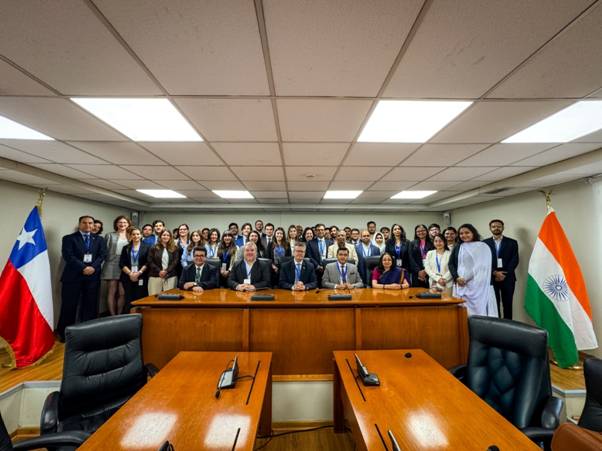
The 9th Round of the India–Peru Trade Agreement negotiations, held in Lima from 3–5 November 2025, registered substantial progress across all core chapters. Discussions covered Trade in Goods and Services, Customs Procedures, Technical Barriers to Trade, Rules of Origin, Dispute Settlement, and the strategically important chapter on Critical Minerals.
Peru’s Minister of Foreign Trade and Tourism, Teresa Stella Mera Gómez, reaffirmed Peru’s commitment to a timely conclusion, stressing the complementarity between the two economies—Peru’s mineral strength and agri-food exports aligning well with India’s demand structures. Indian Ambassador Vishvas Vidu Sapkal emphasised India’s sustained economic momentum and noted that the agreement would reinforce cooperation in pharmaceuticals, automobiles, textiles, food processing, and clean-energy minerals.
From the Peruvian side, officials highlighted deepening Indian interest in copper, lithium, silver, and polymetallic reserves. These commodities underpin India’s energy transition, electric mobility, and electronics manufacturing strategies. According to Peru’s Ministry of Foreign Trade (MINCETUR), bilateral trade has expanded steadily, with Indian pharmaceutical exports and Peruvian mineral exports driving the balance.
Both countries will conduct intersessional consultations ahead of the next round scheduled in New Delhi in January 2026.
India–Chile CEPA: Modernizing a Mature Partnership
A week earlier, from 27–30 October 2025, India and Chile concluded the 3rd Round of CEPA negotiations in Santiago. The discussions covered an extensive range of topics—Trade in Goods and Services, Investment Promotion, Rules of Origin, Intellectual Property Rights, SPS/TBT standards, Economic Cooperation, and Critical Minerals.
Chile remains a central actor in the global critical minerals landscape, accounting for a significant share of global lithium and copper production. Bilateral trade between India and Chile reached close to USD 3 billion in 2024–25, according to Chile’s Ministry of Foreign Affairs. Indian exports of pharmaceuticals, chemicals, auto components and polyester yarn continue to gain traction, while copper ore and refined copper dominate imports.
Both delegations reaffirmed their commitment to “an early and time-bound” conclusion of the CEPA, which aims to upgrade the existing preferential trade agreement of 2007 (expanded in 2017) into a more comprehensive and investment-enabling framework.
The CEPA is expected to support greater market access for Indian goods, strengthen supply-chain resilience, and create structured pathways for cooperation in mining technologies, renewable energy systems, and digital services.
India’s Broader Latin America Strategy: Diversifying Markets and Securing Materials
India’s renewed energy in the region is backed by a clear shift in global trade patterns. With supply-chain diversification gaining urgency worldwide, Latin America has emerged as a high-potential market and a resource-rich partner.
- According to the UN Economic Commission for Latin America (ECLAC), India–Latin America trade crossed USD 50 billion in 2024, driven by India’s imports of crude, minerals and agricultural products, and growing exports of pharmaceuticals, machinery, and textiles.
- Peru and Chile together account for a large share of global copper and lithium reserves—core inputs for India’s clean-energy, electronics, and battery-manufacturing ambitions.
- Indian enterprises, including SMEs, are expanding their presence in agro-processing, information technology services, auto components, and renewable energy solutions across Latin American markets.
- Several market analyses point to rising Indian investment interest in mineral processing, solar components, and engineering services in the Andean region.
For both Peru and Chile, India represents a major growth market for minerals, agri-products, and niche manufacturing goods. For India, these partnerships represent long-term strategic value—stronger market access, diversified sourcing, and deeper integration into emerging value chains.
Looking Ahead: Toward a More Comprehensive India–Latin America Framework
As India prepares to host the next round of the India–Peru negotiations in early 2026, expectations are rising that both agreements—India–Peru FTA and India–Chile CEPA—are moving into accelerated phases. Once concluded, the frameworks are expected to open new opportunities for trade expansion, investment flows, technology partnerships, and SME-driven integration into regional value chains.
India’s renewed engagement with Latin America marks a deliberate strategic shift: building resilient supply networks, expanding export markets, and forging mutually beneficial economic cooperation with a region of considerable natural resources and growing consumer demand.
Author Profile
Latest entries
 FEATURED24 July 2026SME Chamber of India Appoints Jhumarmal Tunwal, Chairman & Managing Director of Tunwal E-Motors as Vice President
 FEATURED23 July 2026Neuberg Diagnostics Cuts Manual HR Tasks by 90% Through AI-Powered HR Transformation with OfficeNet
 FEATURED23 July 2026Gen Z Insurance Advisors Lead in Policy Volumes, While Experienced Advisors Drive Deep Protection Conversations: Probus Report
 FEATURED16 July 2026Currys Business Expands Business Hub Network to Strengthen Technology Support for UK SMEs