






Strategic storytelling is the intentional use of narrative to achieve specific business or leadership goals. It’s about selecting the right story fo the right audience, translating data into meaning and fostering empathy to influence outcomes in areas like branding, change management, sales, fundraising, employer branding and crisis management, making it a powerful tool for leaders.
Here is a founder-friendly taxonomy of strategic stories, followed by practical application areas for business storytelling. This is designed for startup leaders who must sell belief before they sell products.
I. Types of Strategic Stories Startup Founders Can Tell
1. Origin Story
What it does: Establishes authenticity and founder credibility.
Core question answered: Why does this company exist?
Use when: Building trust with early customers, employees, and media.
Signal sent: Purpose precedes profit.
2. Problem Story
What it does: Makes the pain visible and urgent.
Core question: Why must this problem be solved now?
Use when: Pitching investors, onboarding customers.
Signal sent: You understand the market’s reality, not just spreadsheets.
3. Vision Story
What it does: Paints a compelling future state.
Core question: What does the world look like if we win?
Use when: Fundraising, rallying teams, ecosystem building.
Signal sent: Strategic ambition and long-term thinking.
4. Founder Journey Story
What it does: Humanises leadership.
Core question: Why are you the right person to solve this?
Use when: Personal branding, keynote talks, media interviews.
Signal sent: Resilience, learning velocity, skin in the game.
5. Customer Transformation Story
What it does: Converts features into outcomes.
Core question: What changed for the customer after adoption?
Use when: Sales, case studies, website content.
Signal sent: Measurable value creation.
6. Failure & Pivot Story
What it does: Demonstrates judgment and adaptability.
Core question: What did we learn when things broke?
Use when: Investor conversations, leadership credibility.
Signal sent: Governance maturity and decision discipline.
7. Product Evolution Story
What it does: Explains the logic behind product decisions.
Core question: Why does the product look the way it does today?
Use when: Analysts, partners, enterprise customers.
Signal sent: Strategic coherence, not random iteration.
8. Culture & Values Story
What it does: Attracts aligned talent.
Core question: How do we behave when no one is watching?
Use when: Hiring, internal communication, and employer branding.
Signal sent: Culture is designed, not accidental.
9. Category Creation Story
What it does: Reframes the market itself.
Core question: Why are existing labels inadequate?
Use when: Thought leadership, premium positioning.
Signal sent: Market-shaping intent.
10. Impact & Legacy Story
What it does: Connects business to society.
Core question: Why does this startup matter beyond valuation?
Use when: ESG conversations, policy engagement, global forums.
Signal sent: Long-term relevance and stakeholder awareness.
II. Application Areas for Business Storytelling
1. Fundraising & Investor Relations
- Pitch decks
- Annual updates
- Vision alignment
Outcome: Capital follows clarity.
2. Sales & Customer Acquisition
- Discovery calls
- Product demos
- Objection handling
Outcome: Buyers see themselves in the story.
3. Brand & Marketing
- Website narrative
- Social media
- PR and media interviews
Outcome: Differentiation in noisy markets.
4. Leadership & Internal Alignment
- Town halls
- Strategy rollouts
- Change communication
Outcome: Strategy becomes shared meaning, not slides.
5. Hiring & Employer Branding
- Career pages
- Interview conversations
Outcome: Values-aligned talent, lower attrition.
6. Partnerships & Ecosystem Building
- Strategic alliances
- Platform narratives
Outcome: Partners buy into direction, not just deals.
7. Board & Governance Communication
- Board decks
- Strategic reviews
- Risk narratives
Outcome: Better questions, better decisions.
8. Crisis & Reputation Management
- Failure disclosures
- Public responses
Outcome: Trust retained through transparency.
9. Thought Leadership & Category Authority
- Blogs
- Keynotes
- Whitepapers
Outcome: You define the conversation before competitors do.
10. Scaling & Exit Narratives
- IPO story
- Acquisition rationale
Outcome: Valuation justified through narrative logic.
A Final Word
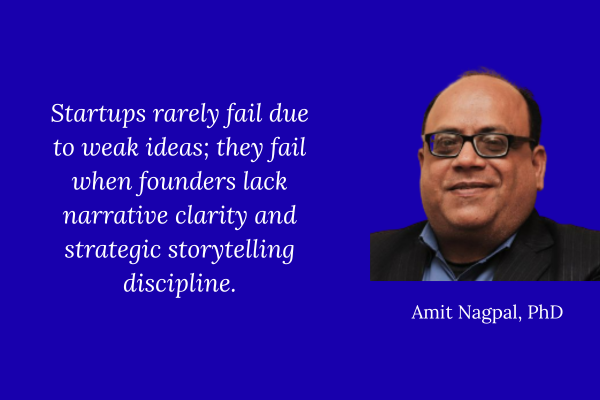
Startups fail less because of weak ideas and more because of weak narrative discipline.
Strategy decides what you do. Storytelling decides whether anyone follows.
Author Profile

- Boardroom Branding Architect for Independent Directors & C-Suite | Building Trust, Credibility & Decision Influence | Strategic Storytelling for Governance | Author | Speaker | Advisor to Board Aspirants
Latest entries
 FEATURED27 January 2026Strategic Storytelling for Startup/SME Founders