



Skip to content
  • News
  • TOP STORIES
  • Enterprise
  • Reports
  • Technology
  • Opinion
  • Reviews
  • Videos
  • Digital issues
  • Issues & Archive
  • Contact

Global SME News

Smarter Markets, Stronger Economies: AI-Driven Deregulation for the Digital Age

  • News
  • TOP STORIES
  • Enterprise
  • Reports
  • Technology
  • Opinion
  • Reviews
  • Videos
  • Digital issues
  • Issues & Archive
  • Contact
  • Toggle search form
  • Thane’s Wagle Estate as a Key Commercial and Business Destination
    Thane’s Wagle Estate as a Key Commercial and Business Destination FEATURED
  • Automotive Brake Fluid Market: From Consumable Input to Safety-Critical Technology Segment
    Automotive Brake Fluid Market: From Consumable Input to Safety-Critical Technology Segment FEATURED
  • From Survival to Strategic Resilience: What MSMEs need in a fragmenting global economy
    From Survival to Strategic Resilience: What MSMEs need in a fragmenting global economy FEATURED
  • Birla Precision Technologies Unveils New Brand Identity to Accelerate Growth in High-Precision and Emerging Sectors
    Birla Precision Technologies Unveils New Brand Identity to Accelerate Growth in High-Precision and Emerging Sectors News
  • Post Budget 2026 | Real Estate: Stability, Infrastructure Momentum, and the Emergence of a Market-Driven Cycle
    Post Budget 2026 | Real Estate: Stability, Infrastructure Momentum, and the Emergence of a Market-Driven Cycle FEATURED
  • Outlook 2026 | Real Estate: Infrastructure-Led Growth, Integrated Communities, and the Trust Imperative
    Outlook 2026 | Real Estate: Infrastructure-Led Growth, Integrated Communities, and the Trust Imperative FEATURED
  • Scaling SMEs: Why Governance Matters as Much as Growth
    Scaling SMEs: Why Governance Matters as Much as Growth FEATURED
  • Quality, Crisis, and Consistency: The Rungta Tea Story
    Quality, Crisis, and Consistency: The Rungta Tea Story Entreprenurs
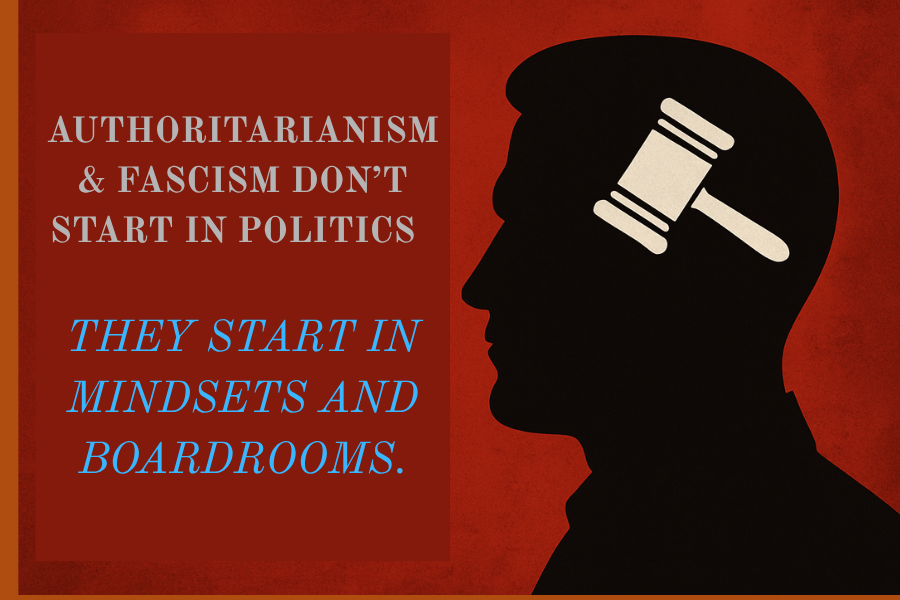
Authoritarianism Begins at Work: Why Businesses Must Guard Against the Psychology of Control

Authoritarianism Begins at Work: Why Businesses Must Guard Against the Psychology of Control

Posted on 7 August 20257 August 2025 By Perumal Koshy No Comments on Authoritarianism Begins at Work: Why Businesses Must Guard Against the Psychology of Control

In times of crisis or transition, the temptation to cling to certainty becomes dangerously appealing. But when certainty turns into absolutism—the belief that “whatever I think, believe, or say is correct, and only my version is valid”—we cross into the realm of authoritarian psychology. This mindset, at its extreme, has historically laid the foundation for Fascism and Nazism. It dehumanizes others, rejects dialogue, and glorifies control.

What we often overlook is that this tendency doesn’t begin in political parties or state structures. It begins with a psychological posture—a refusal to accept complexity, contradiction, or dissent. It begins when leaders or institutions refuse to be questioned, when systems are designed to punish disagreement, and when criticism is treated as betrayal.

In the 1930s, this was the fertile ground that nurtured fascist ideologies. In our own times, it quietly creeps into corporate boardrooms, media narratives, social media algorithms, and enterprise culture.

Absolutism in Business Leadership

Enterprises today operate in dynamic, complex, and often uncertain environments. While decisiveness is a key entrepreneurial trait, it must not morph into ideological rigidity. Many small enterprises, family-owned businesses, and even startups suffer when founders or decision-makers adopt a belief in their infallibility—resisting input, shutting down team feedback, or refusing to adapt.

Authoritarian business environments often:

  • Penalize independent thinking;
  • Reward blind conformity;
  • Mislabel questions as disloyalty;
  • Foster burnout through micromanagement.

This mirrors, in form if not in scale, the same exclusionary logic that totalitarian ideologies imposed on society at large: there is only one right way, and it is mine.

The Economic Cost of Intolerance

Whether in politics or enterprise, absolutist thinking is not just ethically troubling—it is economically unsustainable. Diverse teams, inclusive leadership, and open systems of knowledge-sharing are now recognized as key drivers of innovation. In contrast, rigid hierarchies and top-down control systems limit adaptability and resilience.

The authoritarian mindset is not compatible with a 21st-century economy that depends on collaboration, networks, and co-creation. And yet, many sectors—especially where digital transitions, generational shifts, or political interference are at play—show signs of a growing intolerance toward difference, criticism, or alternative models.

Reclaiming Humility and Dialogue

Whether in a political party, a public institution, or a small enterprise, humility is the first line of defense against fascism. It is the recognition that no one has a monopoly on truth, that progress comes through dialogue, and that leadership includes the ability to listen—and to admit error.

In the business world, this humility shows up in:

  • Participatory management approaches;
  • Learning organizations that embrace feedback;
  • Policies that center inclusion over uniformity.

A pluralistic enterprise culture is not only morally necessary—it is vital for long-term survival.

Fascism begins in the mind long before it shows up in public life. When we declare others wrong by default, dismiss opposing views as threats, or shut down spaces of dialogue, we begin to mirror the same absolutist tendencies that fueled the worst ideologies of the 20th century.

Today, as we navigate volatility across economies, societies, and belief systems, we must ask: Are we building cultures of fear and conformity—or ecosystems of trust, dialogue, and shared futures?

The choice is not merely political. It is deeply personal, professional, and moral.

Author Profile

avatar

Perumal Koshy
Perumal Koshy is Editor of Global SME News and Director of Strategic Initiatives at Enterprise Futures Lab. He writes on MSMEs, enterprise development, and policy issues affecting small business ecosystems.
Linkedin: https://www.linkedin.com/in/caushie/
Latest entries

Author Archives

  • Outlook 2026 | Real Estate: Infrastructure-Led Growth, Integrated Communities, and the Trust ImperativeFEATURED2 February 2026Outlook 2026 | Real Estate: Infrastructure-Led Growth, Integrated Communities, and the Trust Imperative

  • Quality, Crisis, and Consistency: The Rungta Tea StoryEntreprenurs30 January 2026Quality, Crisis, and Consistency: The Rungta Tea Story

  • Entrepreneurship, Values, and Corporate Governance: Building Nations, Not Just ProfitsEntreprenurs21 August 2025Entrepreneurship, Values, and Corporate Governance: Building Nations, Not Just Profits
  •  A New Landmark Report Calls for Rethinking SME Policies, Digital Readiness, and Sustainable GrowthAfrica13 August 2025 A New Landmark Report Calls for Rethinking SME Policies, Digital Readiness, and Sustainable Growth

Business, FEATURED, Human Capital, India, Leadership, Opinion, start-up, TOP STORIES

Post navigation

Previous Post: What Startups Can Learn from Family Businesses—And Vice Versa
Next Post:  A New Landmark Report Calls for Rethinking SME Policies, Digital Readiness, and Sustainable Growth

Leave a Reply Cancel reply

Your email address will not be published. Required fields are marked *

Global SME News

Global SME News, which started in 2008, is dedicated to micro, small and medium enterprises from around the world. It publishes in-depth analysis, market and sectoral reviews as well as news than can help SMEs stay ahead of the curve and acquire the necessary tools to stay relevant in the market.

  • Budget 2025-26: The MSME Blueprint for Global Success & Sustainable Growth
    Budget 2025-26: The MSME Blueprint for Global Success & Sustainable Growth FEATURED
  • Talent Arena 2025: A Game-Changer for Digital Talent, Sets Stage for Bigger 2026 Edition
    Talent Arena 2025: A Game-Changer for Digital Talent, Sets Stage for Bigger 2026 Edition Digital Talent
  • Empowering Women Entrepreneurs: The Surge of Women-Owned MSMEs in India
    Empowering Women Entrepreneurs: The Surge of Women-Owned MSMEs in India FEATURED
  • Industry 5.0: Human-CentricManufacturing and Customization for SMEs
    Industry 5.0: Human-CentricManufacturing and Customization for SMEs FEATURED
  • How Mulund’s Real Estate Is Adapting to New-Age Buyers
    How Mulund’s Real Estate Is Adapting to New-Age Buyers FEATURED
  • TAMWILCOM Launches New Financing Offer for Moroccan Diaspora Projects in Tangier
    TAMWILCOM Launches New Financing Offer for Moroccan Diaspora Projects in Tangier FEATURED
  • Facing Future Cyber Outages: Balancing Technology and Human Capital for Operational Resilience
    Facing Future Cyber Outages: Balancing Technology and Human Capital for Operational Resilience Cyber Security
  • ‘WorldFirst’ Propels Southeast Asian SMEs to Success with Enhanced E-commerce Financial Solutions
    ‘WorldFirst’ Propels Southeast Asian SMEs to Success with Enhanced E-commerce Financial Solutions FEATURED
  • Thane’s Wagle Estate as a Key Commercial and Business Destination
  • Automotive Brake Fluid Market: From Consumable Input to Safety-Critical Technology Segment
  • From Survival to Strategic Resilience: What MSMEs need in a fragmenting global economy
  • Birla Precision Technologies Unveils New Brand Identity to Accelerate Growth in High-Precision and Emerging Sectors
  • Post Budget 2026 | Real Estate: Stability, Infrastructure Momentum, and the Emergence of a Market-Driven Cycle

Copyright © 2026 Global SME News.

Powered by PressBook News WordPress theme