




Lessons from Aninver’s fieldwork in entrepreneurship-support programmes.
In an increasingly fragmented economic landscape marked by reconfigured value chains, tightening financing conditions, and rapidly evolving policy environments, MSMEs are required to operate under continuous uncertainty. Enterprise resilience emerges not from isolated firm-level interventions but from the combined strengthening of capabilities, coordination, and integration. Practical capability-building that drives behavioural change, ecosystem-level coordination that reduces fragmentation, and regional integration that expands market access together enable enterprises to move beyond survival and compete within volatility. Emphasis on measurable outcomes, structured decision frameworks, and proportionate digital adoption highlights the importance of system-oriented approaches that strengthen enterprise ecosystems while enabling MSMEs to operate with greater strategic clarity and long-term resilience.
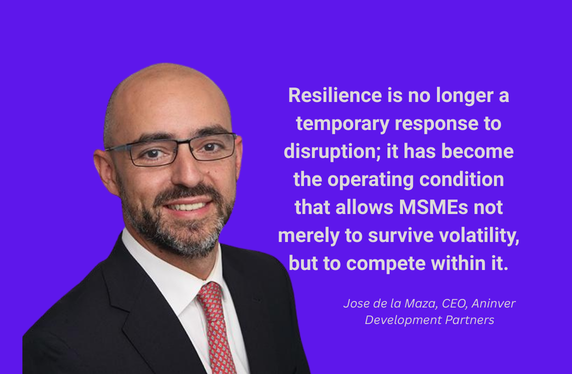
In today’s fragmenting global economy—where value chains are being reconfigured, financing conditions are tightening, and policy environments evolve at increasing speed—micro, small and medium enterprises (MSMEs) are being asked to do more with less. For many businesses, resilience is no longer a temporary response to disruption; it has become a permanent operating condition that shapes strategy, investment, and day-to-day decision-making.
Drawing on Aninver’s experience supporting MSMEs and enterprise ecosystems across multiple regions, one insight emerges consistently: enterprise resilience is rarely built firm-by-firm or in isolation. Instead, it develops when three reinforcing levers are activated simultaneously — capabilities, coordination, and integration. Together, these form the architecture that allows enterprises not merely to survive volatility, but to compete within it.
This article outlines practical lessons from recent programmes — highlighting what worked, what was measured, and what policymakers and ecosystem leaders should prioritise next.
Capabilities that translate into action — not just training attendance
Capability-building is often framed narrowly as “training.” Yet resilience stems not from participation, but from behavioural change: stronger financial planning, proactive risk management, diversified markets, and purposeful digital adoption. Completion rates and diagnostic engagement therefore matter because they signal whether MSMEs can sustain a learning journey while managing everyday operational pressures.
A structured digital transformation programme in Grenada illustrates this point. The initiative reached 57 SMEs, with 63% completing all mandatory components and a further 21% partially completing them — a meaningful achievement in volatile environments where simply following through is itself a resilience trait.
Baseline diagnostics revealed that most participants relied on basic tools such as social media, allocated limited budgets to IT, and prioritised visibility, customer service, and data management. By embedding structured instruments — including a Digital Readiness Assessment, Business Health Survey, and SMART goal-setting — the programme strengthened confidence across critical capability areas.
Key lesson: resilience accelerates when MSMEs are equipped with simple decision frameworks — clear roadmaps, prioritisation tools, and measurable goals — rather than isolated technical content. Practical structure enables strategic thinking.
Coordination as infrastructure: reducing fragmentation and duplication
In many economies, MSME support is not scarce — it is fragmented. Multiple actors implement parallel initiatives, entrepreneurs struggle to navigate the landscape, and institutions often lack the mechanisms to measure system-wide results.
Recent work in The Gambia, funded by the World Bank, identified fragmentation and duplication as core ecosystem weaknesses. Aninver responded by treating coordination not as an administrative function, but as a resilience intervention in its own right.
Ecosystem mapping prioritised three objectives: strengthening the capacity of Enterprise Support Organizations (ESOs), improving national coordination to minimise overlap, and enabling regional integration.
These priorities were operationalised through a collaboration platform featuring a public layer — offering entrepreneurs a directory of services, opportunities, and events — and a secure layer for ESOs that included shared calendars, knowledge libraries, and discussion forums. The intent was explicit: reduce duplication, improve transparency, and support collective learning.
Yet coordination extends beyond digital tools. It requires shared accountability. Standardised monitoring and evaluation instruments, combined with regular reporting requirements, reinforced transparency while enabling system-level insight.
Key lesson: fragmentation is a structural vulnerability; coordination mechanisms are resilience infrastructure.
Integration as strategy in a fragmenting world
Fragmentation is not only global — it is often regional and domestic. Limited connectivity across markets constrains competitiveness, visibility, and investment readiness.
In The Gambia, many ESOs and MSMEs operated in relative isolation from regional networks. The programme therefore positioned regional integration as a strategic pathway to resilience, linking actors to networks, events, and standards that enhance credibility and market access.
Targets included registering ten ESOs with AfriLabs — a pan-African innovation network — by Year 3, alongside facilitating delegations to regional events to build relationships and unlock opportunity.
Key lesson: in uncertain markets, cross-border relationships, recognised standards, and credibility signals become resilience assets — particularly for startups and growth-oriented MSMEs seeking investment or partnerships.
Making resilience measurable
Enterprise programmes frequently over-measure activity while under-measuring outcomes. An ecosystem approach allows for KPI architectures that capture both immediate outputs and longer-term system transformation.
Within WARDIP — a flagship entrepreneurship initiative in The Gambia — the monitoring framework explicitly distinguished short-term results from structural change. Targets included creating 800 jobs by Year 3 and enabling 1,000 MSMEs to access the platform annually, alongside indicators tracking reductions in overlapping activities.
Key lesson: resilience scales when it becomes measurable. Measurement supports adaptive management — not merely retrospective reporting.
Practical digital resilience: what MSMEs actually need
Evidence from tourism-focused MSME programmes in Senegal and Jamaica highlights a pragmatic truth: resilience often begins with foundational improvements. E-commerce readiness, mobile-optimised websites, search engine visibility, digital marketing strategies, and customer management tools frequently deliver the highest immediate returns.
The programmes also demonstrated the value of proportional design. Rather than over-surveying entrepreneurs, teams conducted desk reviews of each firm’s online presence to tailor support — balancing analytical rigour with stakeholder fatigue.
Key lesson: the most effective interventions are often lightweight in administrative burden yet precise in diagnosis — starting with a simple question: What is your current posture, and what is the next practical step?
Three policy priorities for 2026
1. Treat MSME resilience as a system, not a collection of isolated trainings.
Support individual firms, but also reform how ESOs coordinate, report, and complement one another.
2. Invest in capability pathways that drive behavioural change.
Diagnostic tools, strategic roadmaps, and measurable goals help enterprises translate learning into better decisions under uncertainty.
3. Build market access through integration.
Regional platforms, shared standards, and credibility networks are not optional extras — they expand opportunity sets when markets fragment.
Aninver’s contribution to enterprise resilience lies in bridging capability-building, ecosystem governance, and measurable integration strategies. This approach helps MSMEs move beyond survival mode toward strategic resilience — operating with intent rather than reacting to disruption. Recent experience suggests that the strongest results emerge when practical enterprise tools are combined with system-level coordination and credible pathways to market access.
Author Profile

- Jose de la Maza is the CEO of Aninver Development Partners, an international advisory firm specialised in private sector development, entrepreneurship ecosystems, PPPs, and investment preparation across emerging markets. The firm supports governments, donors, and enterprise ecosystems in designing and delivering scalable, measurable programmes.