


In an FMCG landscape often shaped by cost-cutting and short-term scale, Rungta Tea offers a more durable story rooted in consistency, quality, and long-term relationships. In this interview, Girjesh Rungta, Founder and Managing Director of Rungta Tea, reflects on 24 years of enterprise-building—from navigating the disruptions of COVID to accelerating digital transformation without compromising product integrity. Speaking with Perumal Koshy, he shares insights on how trust is sustained across distributors, markets, and generations, and why resilience in small and medium enterprises is ultimately driven by values, adaptability, and deep market understanding.
1. Over the last 24 years, what has been the toughest period for Rungta Tea, and what did you learn from it?
COVID was our biggest test. Everything stopped overnight—cash flows dried up, supply chains broke down, and raw material costs increased by nearly 50%. At that time, we were only about 30% digital. Many companies chose to cut quality to protect margins. We refused to do that.
Instead, we treated the crisis as a moment of transformation. We accelerated our digital adoption from 30% to nearly 90%, spent more personal time with our distributors, and upgraded our production systems. The result surprised even us—we recorded nearly 50% growth after that period, the highest in our 24-year history.
The lesson was simple: when you remain firm on quality and relationships during the worst times, people remember. They stay with you. Tough times don’t break good businesses; they reveal which ones were only pretending to be strong.
2. Rungta Tea has retained most of its distributors for many years. What do you think has helped build this level of trust?
It comes down to quality and treating people right. In this industry, when costs rise, many compromise on the product. We never have. Our distributors know that Rungta Tea will taste the same tomorrow as it does today. That consistency allows them to make a promise to retailers, and retailers to consumers.
But trust goes beyond the product. We have always viewed distributors as partners, not just sales channels. We communicate openly, support them when they need it, and stood by them during COVID when times were extremely difficult.
After more than 50 years in FMCG, I’ve learned one thing clearly—trust takes years to build and just one wrong decision to lose.
3. As the company plans to expand, what are the key things you are careful not to change?
Some things must never change, no matter how big we grow. Quality is at the top of that list. We have never diluted our product to improve margins, and we never will.
Equally important are the relationships we’ve built over decades—with distributors, retailers, and consumers. You cannot grow by weakening the trust that brought you this far. Our way of doing business—transparent, fair, and consistent—must remain intact.
I’ve seen many companies chase scale and forget what made people trust them in the first place. We have survived for 24 years not because we are the largest, but because we are consistent. Growth should strengthen these foundations, not replace them.
4. How have customer preferences and market conditions in the tea sector changed since you started, and how has Rungta Tea adapted?
When we started in 2001, tea was straightforward—strong CTC blends and traditional tastes. Today, consumers want variety: flavoured teas, green tea, tea bags, premix teas, different blends, and new experiences.
We responded by introducing products such as Real Taste Elaichi Tea and Masala Tea—familiar flavours people trust, delivered with the same quality promise. On the business side, almost everything has changed. We are nearly paperless now, have implemented distributor management systems, and digitised close to 90% of our transactions. Modern trade, e-commerce, and government channels all operate very differently today.
What hasn’t changed is consumer preference in our core markets. People in North and East India still love their strong chai. We’ve changed how we operate, but our understanding of what our markets truly want remains our biggest strength.
5. What advice would you give to small and medium business owners trying to build a stable, long-term enterprise?
I started working in our family business when I was 16. After more than 50 years, a few lessons are very clear.
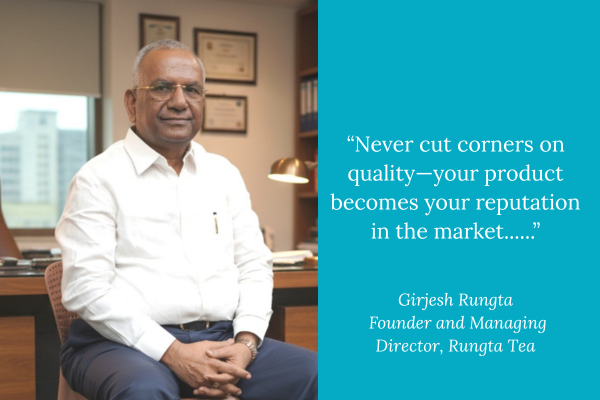
Never cut corners on quality—your product becomes your reputation in the market. Build real relationships, not just transactions. Treat your distributors, employees, and partners well, especially during difficult times. That loyalty will support you later.
Be patient. Rungta Tea took years to build trust—there are no shortcuts. Learn to adapt; we moved from 30% to 90% digital during COVID. But never lose your values while changing. And understand your market deeply. Big brands may have bigger budgets, but local knowledge is a powerful advantage—use it.
Author Profile

-
Perumal Koshy is Editor of Global SME News and Director of Strategic Initiatives at Enterprise Futures Lab. He writes on MSMEs, enterprise development, and policy issues affecting small business ecosystems.
Linkedin: https://www.linkedin.com/in/caushie/
Latest entries
 FEATURED10 April 2026From Conflict to Correction: Evolving Economic Priorities in the Gulf
 FEATURED2 February 2026Outlook 2026 | Real Estate: Infrastructure-Led Growth, Integrated Communities, and the Trust Imperative
 Entreprenurs30 January 2026Quality, Crisis, and Consistency: The Rungta Tea Story
 Entreprenurs21 August 2025Entrepreneurship, Values, and Corporate Governance: Building Nations, Not Just Profits