






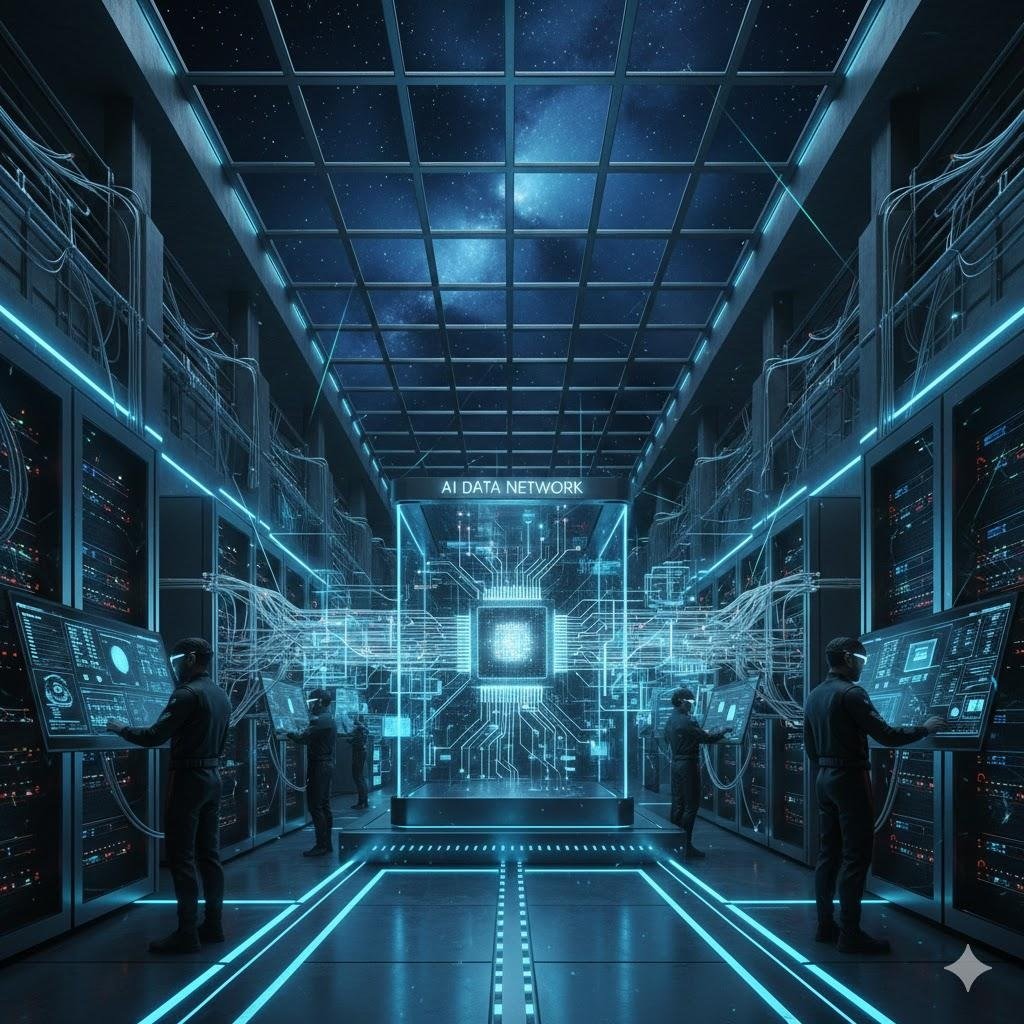
The global AI data center networking market is undergoing rapid expansion, driven by the surging demand for high-performance infrastructure to support artificial intelligence workloads such as deep learning, large language models, and advanced analytics. Valued at USD 7.8 billion in 2024, the market is projected to reach USD 41.6 billion by 2033, growing at a CAGR of 20.5 percent. This growth is fueled by the rise of hyperscale data centers, cloud and hybrid computing environments, and widespread AI adoption across sectors including healthcare, finance, automotive, and retail. Advanced technologies such as high-speed Ethernet, InfiniBand, optical interconnects, and AI-driven network automation are transforming data center operations, enabling ultra-low latency, scalability, and efficient data flow. As AI applications become increasingly data-intensive, AI data center networking is emerging as a critical foundation of the global digital infrastructure.
According to the latest research by Research Intelo, the global AI data center networking market was valued at USD 7.8 billion in 2024 and is projected to expand sharply to USD 41.6 billion by 2033, registering a robust compound annual growth rate (CAGR) of 20.5 percent during the forecast period from 2025 to 2033. This rapid expansion reflects the growing centrality of artificial intelligence workloads in modern digital infrastructure and the corresponding transformation of data center networking architectures.
AI Workloads and the Transformation of Data Center Networks
The AI data center networking market is increasingly recognized as a critical backbone of the contemporary digital economy. As enterprises deploy advanced artificial intelligence models for predictive analytics, automation, generative applications, and real-time decision-making, conventional data center networking systems are proving inadequate. AI workloads—particularly those associated with deep learning, large language models, and advanced analytics—require extremely high bandwidth, ultra-low latency, and seamless scalability.
Next-generation networking solutions are therefore being adopted to enable efficient data flow between graphics processing units (GPUs), AI accelerators, storage systems, and cloud platforms. These high-performance networks are essential for optimizing training and inference processes, reducing bottlenecks, and ensuring that AI systems deliver consistent and reliable performance at scale.
Market Growth and Key Demand Drivers
Several structural drivers are accelerating growth in the AI data center networking market. Foremost among them is the rapid advancement of AI technologies, including generative AI and large-scale neural networks, which dramatically increase east–west traffic within data centers. AI training workloads involve the continuous movement of massive datasets across interconnected computing nodes, placing unprecedented stress on existing networking infrastructure.
The expansion of hyperscale data centers is another significant growth driver. Technology firms and cloud service providers are investing heavily in large-scale facilities designed specifically to support AI-driven workloads. At the same time, AI adoption is broadening across multiple sectors, including healthcare, financial services, automotive manufacturing, and retail, each of which requires reliable, high-speed networking environments to support data-intensive applications.
The growing prevalence of cloud computing and hybrid data center models further reinforces demand. Enterprises increasingly rely on cloud-based AI services while retaining certain workloads on-premises, necessitating advanced networking frameworks capable of handling distributed architectures without compromising security, latency, or reliability.
Structural and Operational Challenges
Despite strong growth prospects, the AI data center networking market faces several notable challenges. High capital expenditure remains a key constraint, particularly for investments in advanced switches, optical interconnects, and AI-optimized networking hardware. For many organizations, especially mid-sized enterprises, the upfront costs of upgrading networking infrastructure can be substantial.
Integration with legacy data center systems presents an additional challenge. Many organizations operate mixed environments where traditional architectures must coexist with modern, high-speed AI networks, increasing deployment complexity and transition timelines. Rising energy consumption and heat generation associated with dense AI workloads further elevate operational costs, intensifying the need for efficient thermal management and power optimization.
Ensuring ultra-low latency, seamless scalability, and robust cybersecurity across distributed and hybrid environments also remains a persistent technical hurdle, particularly as AI workloads become more mission-critical.
Technological Innovations Reshaping the Market
Technological innovation continues to play a central role in shaping the evolution of AI data center networking. High-speed Ethernet, InfiniBand, advanced optical interconnects, and software-defined networking (SDN) are increasingly deployed to address congestion, enhance throughput, and support parallel processing at scale.
In parallel, AI-driven network automation is gaining traction. Intelligent network management platforms leverage machine learning algorithms to optimize traffic routing, predict hardware or performance failures, and dynamically allocate resources. This shift toward autonomous networking significantly reduces operational complexity, improves uptime, and enhances overall efficiency in large and complex data center environments.
Competitive Landscape
- Arista Networks
- Cisco Systems
- Juniper Networks
- Huawei Technologies
- NVIDIA Corporation
- Intel Corporation
- Broadcom Inc.
- Extreme Networks
- Dell Technologies
- Hewlett Packard Enterprise (HPE)
The competitive landscape of the AI data center networking market is characterized by the presence of major global technology providers, including:
These firms are actively investing in high-speed networking solutions, AI-optimized hardware, and integrated platforms designed to meet the evolving requirements of AI-intensive data centers.
Future Outlook
The long-term outlook for the AI data center networking market remains highly positive. As artificial intelligence applications become more pervasive, data-intensive, and embedded across economic sectors, demand for ultra-fast, scalable, and intelligent networking solutions will continue to rise. Emerging domains such as edge AI and, over the longer term, quantum computing are expected to further elevate the strategic importance of data center networks.
In this context, AI data center networking is no longer a supporting component but a foundational enabler of next-generation digital ecosystems. Its continued evolution will be critical to sustaining innovation, competitiveness, and performance in an increasingly AI-driven global economy.
Author Profile
Latest entries
 Entreprenurs7 August 2026More Enabling Digital Regulations Could Add ₩2.4 Trillion (US$1.73 Billion) in Annual VC Investment for South Korean Startups: Oxford Economics
 AI24 July 2026The Creator Economy Platform Market: AI, Digital Entrepreneurship, and the Future of Online Business
 FEATURED9 July 2026Bluevine Expands U.S. Business Banking Solutions to India-Based Entrepreneurs
 FEATURED2 April 2026Parametric Weather Insurance Emerges as a Strategic Risk Instrument for SMEs Amid Rising Climate Volatility