




A new artificial intelligence framework developed in India is reshaping how scientists interpret the biology of cancer, opening the door to a more precise and mechanistic approach to treatment. Moving beyond conventional clinical staging, the study reframes cancer as a dynamic system driven by deeply embedded molecular programs—known as the hallmarks of cancer—that determine how tumors grow, spread, and resist therapy.
For decades, oncology has relied on descriptive systems like TNM, which categorize tumors based on size, lymph-node involvement, and metastasis. While useful for broad classification, these systems fail to capture the molecular heterogeneity that often separates good responders from poor responders—even among patients with the “same” stage. The new framework, OncoMark, developed by scientists at the S N Bose National Centre for Basic Sciences in collaboration with Ashoka University, directly tackles this gap by decoding the molecular “personality” of cancer.
Mapping Cancer’s Hidden Programs
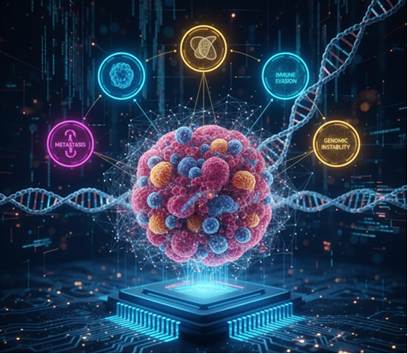
Cancer progression is shaped by a set of hallmark processes such as immune evasion, metastasis, genomic instability, angiogenesis, and resistance to cell death. These hallmarks operate at the cellular level long before clinical symptoms emerge. OncoMark uses advanced neural networks to make these invisible processes measurable.
The research team, led by Dr. Shubhasis Haldar and Dr. Debayan Gupta, analyzed 3.1 million single cells from 14 cancer types, creating synthetic pseudo-biopsies that simulate hallmark-driven tumor states. This unprecedented dataset allowed the AI to learn how hallmark activities interact to drive tumor aggression, treatment evasion, or rapid progression.
A central output of the system is its ability to visualize hallmark activation across cancer stages. This provides a new layer of diagnostic insight: two tumors that appear identical in stage may, in fact, possess radically different underlying biology—and require distinct treatment strategies.
Accuracy Across Real-World Patient Samples
OncoMark demonstrated exceptional predictive capability. The framework reported over 99 percent accuracy in internal testing and remained above 96 percent across five independent cohorts. Its robustness was further established through validation on 20,000 patient samples from eight major global datasets, highlighting its potential applicability across population groups and cancer types.
Importantly, the system does not merely classify tumors; it predicts which hallmark programs are active in an individual patient’s cancer. This capability can guide clinicians toward drugs that specifically target those biological pathways, creating a pathway for personalized therapy rooted in molecular behavior rather than broad-stage categories.
Pushing Oncology Toward Precision
By offering clinicians a deeper view of tumor biology, OncoMark can help identify cancers that might appear less aggressive under standard staging but exhibit hallmarks associated with rapid progression. This supports earlier intervention and more tailored treatment plans. Conversely, the framework could help avoid overtreatment in cases where hallmark activity suggests indolent disease.
Published in Communications Biology (Nature Publishing Group), the study represents a significant advance in the integration of AI with molecular oncology. As precision medicine continues to evolve, tools such as OncoMark demonstrate how computational modeling can illuminate the biological scripts that drive cancer—and enable therapies that respond to those scripts.
Author Profile
Latest entries
 News15 March 2026Qualys Named a Leader in 2026 Forrester Wave™ for Cloud-Native Application Protection Solutions
 News13 March 2026Digital Asset Management Market Forecast to Reach USD 17.3 billion by 2033
 FEATURED25 February 2026Thane’s Wagle Estate as a Key Commercial and Business Destination
 FEATURED16 February 2026Automotive Brake Fluid Market: From Consumable Input to Safety-Critical Technology Segment