


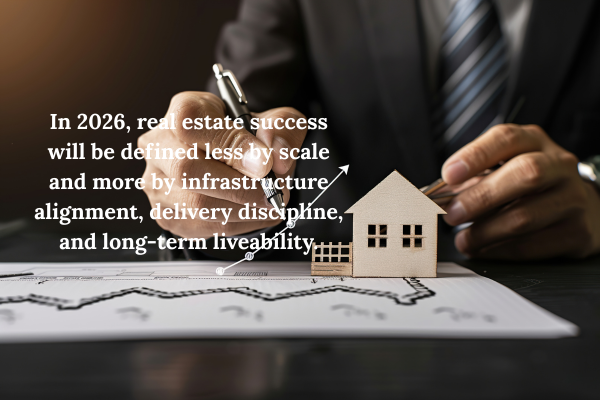
As India’s real estate sector enters 2026, growth is becoming more selective, infrastructure-anchored, and trust-driven. The next phase is defined less by scale and speculation, and more by integrated communities, redevelopment, and alignment with long-term urban systems. Public infrastructure investments, evolving buyer expectations, and stronger governance norms are reshaping where and how value is created. Developers who prioritise delivery discipline, connectivity, and community-centric design are emerging as leaders in a maturing market—signalling a decisive shift from volume-led expansion to strategic urban value creation.
As India’s real estate sector steps into 2026, the contours of growth are becoming clearer—and more disciplined. After a strong recovery phase marked by record registrations and renewed buyer confidence, the sector is now transitioning from expansion-driven momentum to a phase defined by infrastructure alignment, redevelopment, and long-term urban value creation. Developers across the Mumbai Metropolitan Region (MMR) point to a convergence of public infrastructure investment, evolving consumer expectations, and tighter governance standards as the forces shaping the next cycle. The emphasis is shifting decisively toward certainty, integrated living, and projects that are embedded within the broader urban system rather than isolated developments.
Voices from the Sector
Reflecting on this transition, Bhavesh Shah, Joint Managing Director of Today Group, observes that the sector is moving beyond scale alone.
“As we head into 2026, Indian real estate is moving from simple expansion to purpose-driven evolution. The next era will be shaped by integrated ecosystems, smarter last-mile connectivity, and a renewed focus on trust-led and sustainable development. Homebuyers today seek more than just homes — they want certainty, meaningful community, and a lifestyle that grows in long-term value.”
A similar infrastructure-led outlook emerges from peripheral and emerging corridors. Jash Panchamia, Promoter, Suraksha Smart City, highlights how extended suburban regions are entering the spotlight.
“Mumbai’s extended suburban areas led by Vasai’s emergence as the ‘Fourth Mumbai’ will steer 2026 real estate trends. Mega townships with proximity to railway lines and the metro, use of precast technology, and forest-themed greens will define affordable, amenity-rich living.”
Infrastructure, however, is not only about new regions but also about reshaping existing urban choices. Mayur R. Shah, Vice-Chairman, Marathon Nextgen Realty Ltd., underlines how transport projects are redrawing the residential map.
“Transformational infrastructure such as the Mumbai Trans Harbour Link, Metro Line 4, and new tunnel roads will dramatically cut commute times. These projects will change how people choose where to live and which micro-markets emerge next.”
From a broader citywide perspective, Vivek Mohanani, CEO & MD, Ekta World, points to a three-fold convergence shaping 2026.
“Infrastructure, policy, and evolving consumer aspirations are coming together. Metro corridors, the coastal road extension, and the new airport at Navi Mumbai will unlock value, while redevelopment policies will ensure safer, modern homes for citizens.”
Beyond infrastructure and redevelopment, technology and sustainability are becoming structural, not optional. Vishal Ratanghayra, Founder & CEO, Platinum Corp, notes:
“2026 will see deeper integration of AI-driven PropTech, a stronger push toward ESG-led sustainability, and the rise of asset classes such as senior living, co-living, and data centres. The sector is moving toward future-ready communities rather than standalone projects.”
Cluster development within the city is another defining theme. Ruchit Mehta, Partner, Mehta Realty, explains:
“Western suburbs such as Malad, Goregaon, and Kandivali will witness growth driven by cluster developments that integrate homes, offices, and retail. These communities reduce commute times and enhance everyday living.”
At the same time, buyer expectations are becoming more values-driven. Chintan Sheth, Chairman & Managing Director, Sheth Realty, reflects:
“Buyers today seek more than homes — they seek experiences rooted in wellbeing, transparency, and trust. The future belongs to those who build with intention and resilience.”
Integrity and delivery discipline also remain central to the narrative. Aditya N. Shah, Director, Mayfair Housing, highlights:
“Timely occupation certificates, redevelopment, and mixed-use launches across MMR will underscore an integrity-driven ethos that supports sustainable urban transformation.”
Finally, township-scale development and community-oriented formats are expected to gain further momentum. Anuj Goradia, Director, Dosti Realty, notes:
“Senior living, integrated townships, and community-focused developments supported by strong connectivity and social infrastructure will define MMR’s next growth cycle.”
What These Signals Indicate for 2026
Taken together, these perspectives reveal a sector entering a phase of consolidation and maturity. Infrastructure is no longer a background enabler but the primary demand trigger. Integrated townships and mixed-use clusters are emerging as practical responses to congestion, affordability pressures, and changing work-life patterns. Trust—expressed through timely delivery, regulatory compliance, and transparent governance—is becoming a decisive market differentiator. At the same time, technology adoption and ESG alignment are reshaping how projects are designed, built, and positioned.
The outlook for 2026 suggests that real estate growth will be measured less by volume and more by relevance to the urban system. Developers who align projects with infrastructure timelines, prioritise redevelopment and community living, and demonstrate delivery credibility are likely to lead the next cycle. For homebuyers and investors, the focus is shifting toward long-term liveability, resilience, and certainty. As Indian cities evolve, real estate is moving beyond asset creation toward the shaping of durable urban ecosystems—marking 2026 as a year of strategic maturity rather than speculative expansion.
Author Profile

-
Perumal Koshy is Editor of Global SME News and Director of Strategic Initiatives at Enterprise Futures Lab. He writes on MSMEs, enterprise development, and policy issues affecting small business ecosystems.
Linkedin: https://www.linkedin.com/in/caushie/
Latest entries
 FEATURED10 April 2026From Conflict to Correction: Evolving Economic Priorities in the Gulf
 FEATURED2 February 2026Outlook 2026 | Real Estate: Infrastructure-Led Growth, Integrated Communities, and the Trust Imperative
 Entreprenurs30 January 2026Quality, Crisis, and Consistency: The Rungta Tea Story
 Entreprenurs21 August 2025Entrepreneurship, Values, and Corporate Governance: Building Nations, Not Just Profits