


Most SMEs don’t fail for lack of ambition or opportunity; they fail because governance does not mature alongside growth. As enterprises scale, agility without institutional discipline turns into fragility. Board-level mentoring bridges this gap—embedding risk awareness, decision clarity, and financial discipline without stifling entrepreneurial energy. Growth creates momentum; governance ensures endurance.
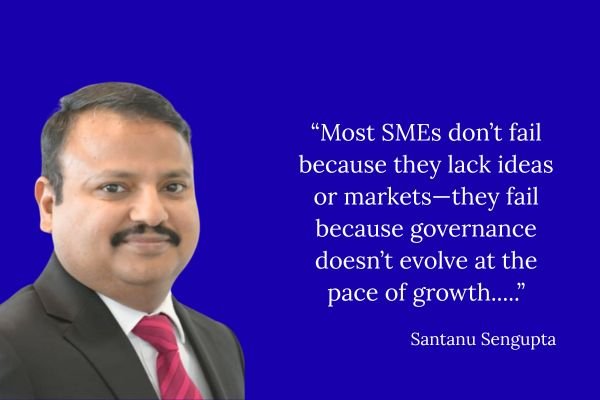
Most SMEs don’t fail because they lack ambition, innovation, or market opportunity. They fail because governance does not evolve at the same pace as growth.
Having worked closely with boards and advised founder-led enterprises across stages and geographies, I have seen this pattern repeatedly. Entrepreneurs build strong products and gain early traction, but as complexity increases—new markets, new capital, new stakeholders—the absence of governance discipline begins to show. What once felt like agility starts to resemble fragility. Growth continues, but resilience does not.
Governance, in this context, is not about control or compliance. It is about building the institutional muscle required to scale sustainably. And this is where board-level mentoring can be a decisive inflection point for SMEs.
The hidden gap in scaling enterprises
SMEs operate in an environment defined by speed. Decisions are frequent, roles overlap, and priorities shift rapidly. This flexibility is essential in the early phases of growth. However, as organisations scale, informal decision-making, founder-centric authority, and lightweight controls begin to create structural risk.
Boards, by design, bring a different lens. They exist to provide oversight, long-term perspective, and disciplined challenge. When introduced too late, boards are often perceived as bureaucratic overlays and mechanisms that slow down execution. But when board thinking is embedded early, through mentoring rather than enforcement, it creates clarity rather than constraint.
The most resilient SMEs are those that learn to integrate governance into their operating rhythm without sacrificing entrepreneurial energy.
What board-level mentoring brings to scaling SMEs
Risk awareness without risk aversion
Experienced directors do not dilute ambition; they sharpen it. Through board-level mentoring, founders learn to recognise risks that are often invisible during rapid growth eg. regulatory exposure, financial control gaps, data and cyber vulnerabilities, reputational dependencies.
Addressing these early does not slow momentum. It reduces disruption. SMEs that anticipate risk rather than react to crises retain strategic optionality as they scale.
Decision frameworks that grow with the organisation
As SMEs expand, the volume and complexity of decisions increase dramatically. What works with a small leadership team becomes inconsistent across larger, distributed teams.
Board mentors introduce scalable decision frameworks including clarity on authority, escalation, and accountability. These frameworks do not replace founder judgment; they institutionalise it. Over time, they enable faster, better-aligned decisions across the organisation.
Credibility with capital providers and regulators
Capital today is increasingly selective. Investors and lenders differentiate not just on growth metrics, but on governance quality. Strong governance signals maturity, predictability, and stewardship.
SMEs with board-level discipline navigate funding discussions, regulatory engagement, and stakeholder scrutiny with greater confidence. They answer difficult questions proactively, not defensively. In many cases, governance becomes a tangible differentiator in accessing better capital on better terms.
Succession and continuity beyond the founder
Many SMEs are built around the founder’s vision, energy, and relationships. While this concentration of leadership can accelerate early growth, it becomes a vulnerability as scale increases.
Board-level mentoring encourages founders to build leadership depth, clarify roles, and plan for continuity. Succession is not a sign of exit intent; it is a sign of institutional maturity. Enterprises that address this early are better equipped to navigate transitions without value erosion.
Financial discipline as a strategic capability
Growth can obscure weak financial discipline, until it no longer can. Cash flow governance, reporting rigor, compliance discipline, and capital allocation frameworks are often introduced reactively, under pressure.
Board mentors help embed these disciplines early, transforming finance from a reporting function into a strategic capability. The result is not conservatism, but sustainability.
Misconceptions that hold SMEs back
From the SME perspective, boards are often viewed as necessary only at scale, or as mechanisms imposed by investors. Governance is seen as something to be “added later.”
From the board perspective, SMEs can appear informal, chaotic, or under-structured, leading some directors to default to rigid governance models that are ill-suited to entrepreneurial environments.
Both perspectives miss the opportunity.
Smart founders see governance as an accelerator, not a brake.
Smart directors see SMEs as environments where governance must be adaptive, proportionate, and context-aware.
The real bridge: board-level mentoring
The most effective bridge between entrepreneurial speed and institutional discipline is not compliance, it is mentoring.
Board-level mentoring respects the pace at which SMEs operate while gradually embedding the structures required for scale. It focuses on asking better questions, not prescribing rigid answers. It helps founders transition from operators to stewards, without losing their entrepreneurial edge.
This approach transforms governance from an obligation into an asset.
A maturing SME ecosystem
Across markets, SMEs are entering a more demanding phase of growth. Stakeholders including investors, regulators, partners, and customers expect greater transparency, accountability, and resilience.
The next generation of successful SMEs will not be defined by innovation alone. They will be defined by their ability to institutionalise good judgment.
Growth creates opportunity.
Governance determines longevity.
The most enduring enterprises are those that recognise this early, before scale exposes what governance failed to prepare.
Author Profile

-
Santanu Sengupta is an accomplished senior Global Banking executive, with three decades of leadership experience shaping business growth, governance, risk management, strategy and transformation at leading international banks. As former Managing Director & APAC South Head at Wells Fargo Bank, Singapore, he led diverse businesses and cross-border teams across 15 countries.
He currently serves as Advisor to Boards & Startups in technology-enabled businesses, bringing contemporary expertise in AI governance, Cyber resilience, ESG stewardship and Digital oversight, to his rich and diversified experience across Finance, Banking, Capital Markets, Risk Management, Global Payments & Trade and Talent& Culture Stewardship.
Santanu is widely recognized for his thought leadership on Responsible Innovation, AI Governance, ESG & Sustainability, Risk Management and Purpose -driven Leadership.
