


Skip to content
  • News
  • TOP STORIES
  • Enterprise
  • Reports
  • Technology
  • Opinion
  • Reviews
  • Videos
  • Digital issues
  • Contact

Global SME News

Smarter Markets, Stronger Economies: AI-Driven Deregulation for the Digital Age

  • News
  • TOP STORIES
  • Enterprise
  • Reports
  • Technology
  • Opinion
  • Reviews
  • Videos
  • Digital issues
  • Contact
  • Toggle search form
  • The rise of eco-living: Why the demand for sustainable homes is accelerating in Indian cities
    The rise of eco-living: Why the demand for sustainable homes is accelerating in Indian cities Uncategorised
  • LogRhythm | Exabeam Expands Saudi Presence with MIS Partnership and New Customer Innovation Center in Riyadh
    LogRhythm | Exabeam Expands Saudi Presence with MIS Partnership and New Customer Innovation Center in Riyadh Cyber Security
  • Bioeconomy, Circular Economy, and Post-Growth Paradigms: Rethinking Economic Expansion
    Bioeconomy, Circular Economy, and Post-Growth Paradigms: Rethinking Economic Expansion Circular Economy
  • AI Unlocks Cancer’s Hidden Biology, Paving the Way for Truly Personalized Therapy
    AI Unlocks Cancer’s Hidden Biology, Paving the Way for Truly Personalized Therapy AI
  • Distributed Digital Natives: How a New Entrepreneurial Class Is Rewriting Innovation Ecosystems
    Distributed Digital Natives: How a New Entrepreneurial Class Is Rewriting Innovation Ecosystems Entreprenurs
  • UNIDO Launches Vision 2050 and Industrial Development Report 2026, Outlining a Global Blueprint for Future Industrialization
    UNIDO Launches Vision 2050 and Industrial Development Report 2026, Outlining a Global Blueprint for Future Industrialization News
  • How Mulund’s Real Estate Is Adapting to New-Age Buyers
    How Mulund’s Real Estate Is Adapting to New-Age Buyers FEATURED
  • Amul and IFFCO Top Global Rankings: A New Benchmark for Inclusive Enterprise Models
    Amul and IFFCO Top Global Rankings: A New Benchmark for Inclusive Enterprise Models FEATURED
The Next Big Leap in Construction: How Precast Technology Is Shaping the Future of Housing

The Next Big Leap in Construction: How Precast Technology Is Shaping the Future of Housing

Posted on 6 November 20257 November 2025 By Jash Panchamia No Comments on The Next Big Leap in Construction: How Precast Technology Is Shaping the Future of Housing

Precast construction technology is transforming India’s housing industry with faster, cleaner, and more sustainable building methods. By replacing traditional on-site work with precision-engineered factory-made components, developers are delivering affordable, high-quality homes at record speed. This innovation is reshaping how cities like Mumbai build, buy, and live — setting new standards in construction efficiency and smart urban development.

Mumbai is a hub for construction activity, and a short drive around is enough for one to experience the sound of concrete mixers, swirling dust, and endless commotion. This is the usual scene at any construction site in Mumbai. But think of a situation that is something far more composed, where there are no ready-mix concrete trucks lining up on-site but instead, there are ready-made building parts arriving quietly and being slotted together with surprising ease. The air around feels a lot cleaner and the ground is clear of waste, with the steady hum of organised work replacing the regular chaos. 

As India moves ahead on the path of progress so is the construction industry. You may have read about AI, along with AR and VR being used widely, but what is also making a silent revolution is the use of precast technology. As urbanisation accelerates the demand for affordable, high-quality homes growing, the construction industry is turning a leaf with the use of precast technology. The cleaner and less chaotic construction site that one gets with using precast is also the reason it promises to redefine how homes are built and delivered.

The advantages at site include workers get to breathe better air, neighbours notice less noise, and buyers will notice how the project progresses at a steady, more assured pace. This is the difference precast construction is about. It ensures that factory level precision comes to building sites, it acts against pollution, saves time, and leads through a much calmer, and a more sustainable way to build homes. This is an advantage to the construction industry, especially in our crowded cities, where space and clean air come at a premium.

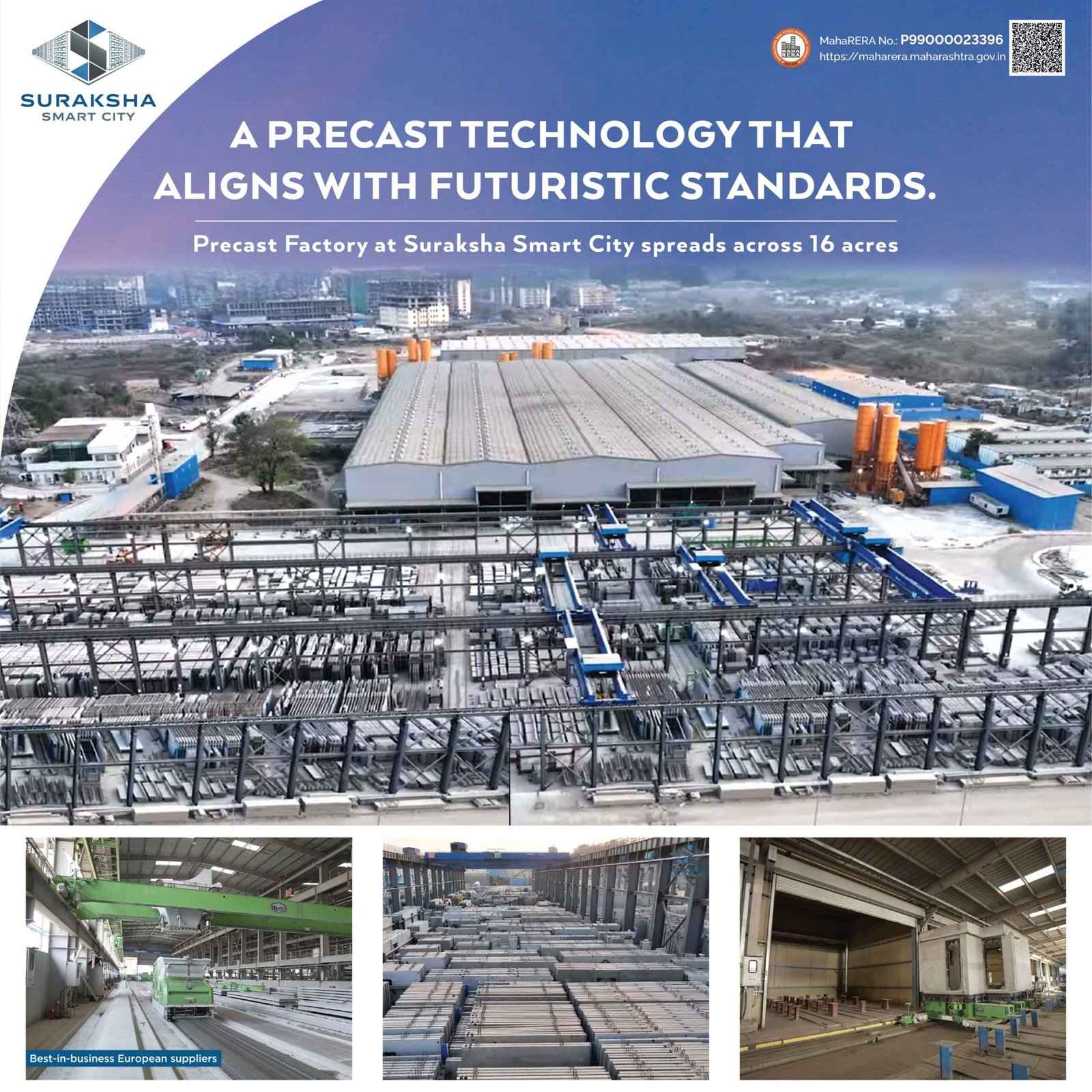
The other quiet revolution that precast technology has given India’s housing sector is the ability to build affordable and high-quality homes. With the demand for this at a peak the construction industry is seeing the value that precast holds. How this technology works is that walls, slabs, staircases, and even entire 3D modules are made in a controlled factory environment. Once cast and ready they are moved to the construction site for assembly. This is a very different approach from conventional labour-intensive methods. The reliance on a heavy on-site work model spread across vast areas is absent.  The method here ensures that the bulk of building works take place under stringent quality controls within a regulated atmosphere. This shift is beyond just procedural and fundamentally enhances the whole homebuying experience.

For prospective homeowners, the benefits are tangible. Components made in a factory are stronger and dimensionally accurate. They also consistently remain high in quality, limiting the possibility of defects and the need to undertake costly repairs. Construction timelines come down by a significant margin, as site preparation and factory production can occur simultaneously. This allows residents to get possession of their new homes faster. Safety forms another critical advantage, with controlled factory environments reducing workplace hazards. On-site assembly also demands less labour and involves fewer risks of accidents.

Since sustainability is an increasingly important aspect of modern construction, and precast methods support eco-friendly practices is also becomes a direction for greener building practices. In addition, the precision followed by the assembly process lowers on-site scope of any disruption, providing a more pleasant working environment for communities under development. 

Although construction with precast as a technology is fast progressing its adoption. In the context of the Indian market is not moving in equal measure. But this is also changing with ease of obtaining capital investment set to make setting up precast factories a simpler process. Transporting large concrete modules and standardising designs to accommodate diverse local architectural styles are seen as part of logistical hurdles which will ease when the pace of adoption goes up. Similarly, the availability of a skilled labour force for on-site assembly remains in short supply in various parts of India towards which developers are investing in training to fully realise the technology’s potential.

As these areas of challenge get addressed through various policy initiatives, the outlook for precast technology in India is upbeat with advancements in 3D casting and use of digital tools like Building Information Modelling (BIM) improving precision and enabling customised designs that accelerate construction. Large-scale developers are betting strongly on setting up precast factories, which is signal toward corporate commitment to innovation, sustainability, and timely delivery. For homebuyers, this is as transformative as it can get. Precast construction methods are a mode of faster project delivery of developments that are structurally robust, resilient, and built to meet modern safety and seismic standards. Even as cost overruns are minimised, timelines get predictable, and the overall living experience is enhanced.

Finally, in a market where traditional construction methods are often slow, labour-intensive, and prone to quality fluctuations, precast technology has set a new benchmark. By combining speed, precision, sustainability, and safety, it has made quality housing more accessible and reliable for millions of Indians. As the industry welcomes mechanisation and modern construction techniques, precast construction has now become a strategic innovation that will reshape India’s housing landscape, so that the homes of tomorrow are delivered with greater certainty, efficiency, and care.

Author Profile

Jash Panchamia

Jash Panchamia
Mr. Jash Panchamia is the Promoter, Suraksha Smart City

Latest entries

Author Archives

  • The Next Big Leap in Construction: How Precast Technology Is Shaping the Future of HousingFEATURED6 November 2025The Next Big Leap in Construction: How Precast Technology Is Shaping the Future of Housing

FEATURED, India, innovation, Reports, TOP STORIES

Post navigation

Previous Post: India’s Cybersecurity Landscape: Startups, Skilled Talent, and Global Partnerships Drive a $20 Billion Security Industry
Next Post: India Deepens Economic Footprint in Latin America as Trade Negotiations with Peru and Chile Gain Strong Momentum

Related Posts

  • Unlocking Green Innovation: How EPA’s .8 Million is Supercharging Small Businesses in the Green Tech Space
    Unlocking Green Innovation: How EPA’s $2.8 Million is Supercharging Small Businesses in the Green Tech Space Enviornment
  • Leveraging BRICS for Industrial Development: A Critical Review of IID Policy Brief 17
    Leveraging BRICS for Industrial Development: A Critical Review of IID Policy Brief 17 Reports
  • EU’s €200 Billion AI Initiative: A Boon for small scale enterprises or a Battle for Survival?
    EU’s €200 Billion AI Initiative: A Boon for small scale enterprises or a Battle for Survival? AI
  • Amul and IFFCO Top Global Rankings: A New Benchmark for Inclusive Enterprise Models
    Amul and IFFCO Top Global Rankings: A New Benchmark for Inclusive Enterprise Models FEATURED
  • Middle Market SMEs Brace for Growth: AI, Cybersecurity, and Workforce Retention Take Center Stage
    Middle Market SMEs Brace for Growth: AI, Cybersecurity, and Workforce Retention Take Center Stage FEATURED
  • Oil rich middle east economies are in transition, From oil and petroleum to non-oil sectors
    Oil rich middle east economies are in transition, From oil and petroleum to non-oil sectors FEATURED

Leave a Reply Cancel reply

Your email address will not be published. Required fields are marked *

Global SME News

Global SME News, which started in 2008, is dedicated to micro, small and medium enterprises from around the world. It publishes in-depth analysis, market and sectoral reviews as well as news than can help SMEs stay ahead of the curve and acquire the necessary tools to stay relevant in the market.

  • Covid-19 impact: Nearly half of the global workforce at risk of losing livelihoods
    Covid-19 impact: Nearly half of the global workforce at risk of losing livelihoods Business
  • Budget 2025-26: The MSME Blueprint for Global Success & Sustainable Growth
    Budget 2025-26: The MSME Blueprint for Global Success & Sustainable Growth FEATURED
  • Moldova: IFC to Help Boost Access to Finance for Smaller Businesses, Women Entrepreneurs
    Moldova: IFC to Help Boost Access to Finance for Smaller Businesses, Women Entrepreneurs News
  • Microsoft’s ‘Zero Day Quest’: A  Million Challenge to Revolutionize AI and Cloud Security!
    Microsoft’s ‘Zero Day Quest’: A $4 Million Challenge to Revolutionize AI and Cloud Security! AI
  • Snowman Logistics on an expansion mode; adds more warehousing capacity
    Snowman Logistics on an expansion mode; adds more warehousing capacity News
  • Implementation of Energy Efficiency measures in India saves a substantial amount of CO2 emissions
    Implementation of Energy Efficiency measures in India saves a substantial amount of CO2 emissions Enviornment
  • The Biggest Global Economic Shift in a Century is Happening NOW!
    The Biggest Global Economic Shift in a Century is Happening NOW! FEATURED
  • Empowering MENA SMEs to Embrace Net-Zero Strategies: COP28 Presidency Unveils Dedicated Program
    Empowering MENA SMEs to Embrace Net-Zero Strategies: COP28 Presidency Unveils Dedicated Program News
  • The rise of eco-living: Why the demand for sustainable homes is accelerating in Indian cities
  • LogRhythm | Exabeam Expands Saudi Presence with MIS Partnership and New Customer Innovation Center in Riyadh
  • Bioeconomy, Circular Economy, and Post-Growth Paradigms: Rethinking Economic Expansion
  • AI Unlocks Cancer’s Hidden Biology, Paving the Way for Truly Personalized Therapy
  • Distributed Digital Natives: How a New Entrepreneurial Class Is Rewriting Innovation Ecosystems

Copyright © 2025 Global SME News.

Powered by PressBook News WordPress theme