




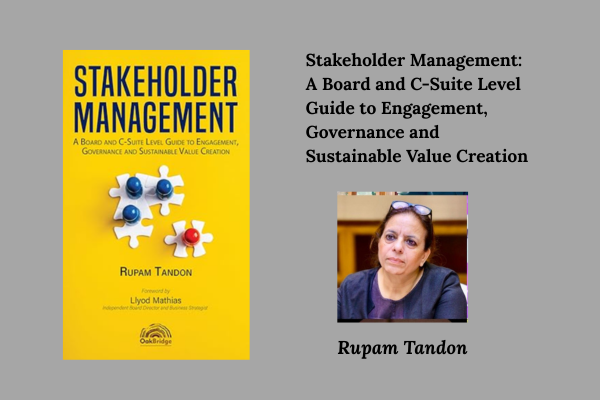
Stakeholder Management: A Board and C-Suite Level Guide to Engagement, Governance and Sustainable Value Creation: Rupam Tandon
In today’s economic landscape, enterprises no longer operate within neat, clearly defined market boundaries. They function within dense and often unpredictable networks of stakeholders—investors, regulators, employees, communities, and increasingly, digital publics. Each of these actors shapes not only business outcomes but also institutional legitimacy. As a result, corporate decision-making is no longer driven by financial metrics alone; it is filtered through expectations of trust, accountability, and social relevance. In this context, stakeholder management has moved decisively from a peripheral concern to a central pillar of governance.
It is within this shifting terrain that Stakeholder Management: A Board and C-Suite Level Guide to Engagement, Governance and Sustainable Value Creation by Rupam Tandon finds its relevance. The book responds to a clear and growing gap: the lack of structured, practice-oriented frameworks that help senior leadership engage complex stakeholder environments without reducing the process to compliance or reputation management.
Book Details
- Title: Stakeholder Management: A Board and C-Suite Level Guide to Engagement, Governance and Sustainable Value Creation
- Author: Rupam Tandon
- Publisher: OakBridge Publishing
- Publication Date: March 2026
- Edition: First Edition
- Format: Paperback
- Pages: 130
- ISBN: 978-81-996245-6-6
About the Author
Rupam Tandon is a seasoned financial services leader, global strategist, board advisor, and governance practitioner with over three decades of experience spanning investment banking, strategic advisory, board leadership, and startup governance. Her career reflects a combination of deep domain expertise in financial systems and a sustained engagement with evolving governance frameworks across both corporate and entrepreneurial contexts.
She began her professional journey in financial markets and investment banking, going on to hold senior roles with leading global institutions. Over a 30+ year career, she has built capabilities across banking, compliance, risk management, strategic partnerships, and organizational transformation, with experience spanning India, the United Kingdom, the United Arab Emirates, and North Africa. This cross-regional exposure lends her work a grounded understanding of global financial systems, regulatory environments, and cultural variations in business practice.
In addition to her executive experience, Rupam is a Certified Independent Director and an active voice in governance discourse. She regularly engages with industry forums on issues of governance, risk, and ethics, and contributes to advisory platforms that shape board-level thinking—particularly in the context of scaling organizations and emerging enterprises. Her work increasingly focuses on embedding governance as a strategic function rather than a compliance obligation.
Beyond formal roles, she mentors women leaders, advises founders on governance readiness, and advocates for ethical leadership as a driver of long-term value creation across enterprises of varying scale and maturity.
Its importance is also a matter of timing. Across sectors, organizations are navigating layered pressures—ESG mandates, regulatory scrutiny, technological disruption, and constant public visibility. Yet much of the existing literature tends to fall into two extremes: either overly theoretical or simplified into checklists that fail to capture the fluid and often contested nature of stakeholder relationships. The gap between conceptual understanding and actionable governance remains significant. Books that attempt to bridge this divide are not just useful—they are necessary.
Tandon’s work makes a meaningful contribution in this regard. It positions stakeholder management not as a communication function, but as a strategic capability embedded within decision-making structures. Through structured frameworks, practical insights, and attention to conflict navigation, the book aligns stakeholder engagement with institutional strategy rather than treating it as an occasional intervention. This is particularly relevant in environments where stakeholder expectations are constantly evolving, shaped by digital technologies, data systems, and new forms of participatory engagement.
A notable strength of the book is its recognition that stakeholder tensions are not exceptions, but inherent features of modern organizations. Too often, competing interests are treated as disruptions to be managed reactively. Here, they are reframed as opportunities for strategic clarity and institutional strengthening—provided they are engaged with systematically. For boards and senior executives operating in uncertain and multi-layered environments, this is a valuable shift in perspective.
From a wider enterprise and policy standpoint, the relevance of stakeholder-centric thinking extends beyond large corporations. Micro, small, and medium enterprises, as well as emerging ventures, increasingly face similar challenges—whether in accessing finance, engaging local communities, or navigating regulatory systems. Yet these enterprises often lack the tools to structure and articulate stakeholder relationships effectively. In that sense, contributions like this book also feed into a broader conversation on building more resilient and inclusive enterprise ecosystems.
Ultimately, the value of this work lies not only in what it presents, but in where it sits within the evolving governance discourse. As economies become more interconnected and accountability frameworks more demanding, the ability to engage stakeholders in a structured and strategic manner will increasingly define institutional success. This book reinforces stakeholder management as a discipline—analytical, grounded, and central to sustainable value creation.
In that sense, it is more than a practitioner’s guide. It reflects a wider shift in how enterprises understand their role within society.
Author Profile
Latest entries
 Entreprenurs7 August 2026More Enabling Digital Regulations Could Add ₩2.4 Trillion (US$1.73 Billion) in Annual VC Investment for South Korean Startups: Oxford Economics
 AI24 July 2026The Creator Economy Platform Market: AI, Digital Entrepreneurship, and the Future of Online Business
 FEATURED9 July 2026Bluevine Expands U.S. Business Banking Solutions to India-Based Entrepreneurs
 FEATURED2 April 2026Parametric Weather Insurance Emerges as a Strategic Risk Instrument for SMEs Amid Rising Climate Volatility