





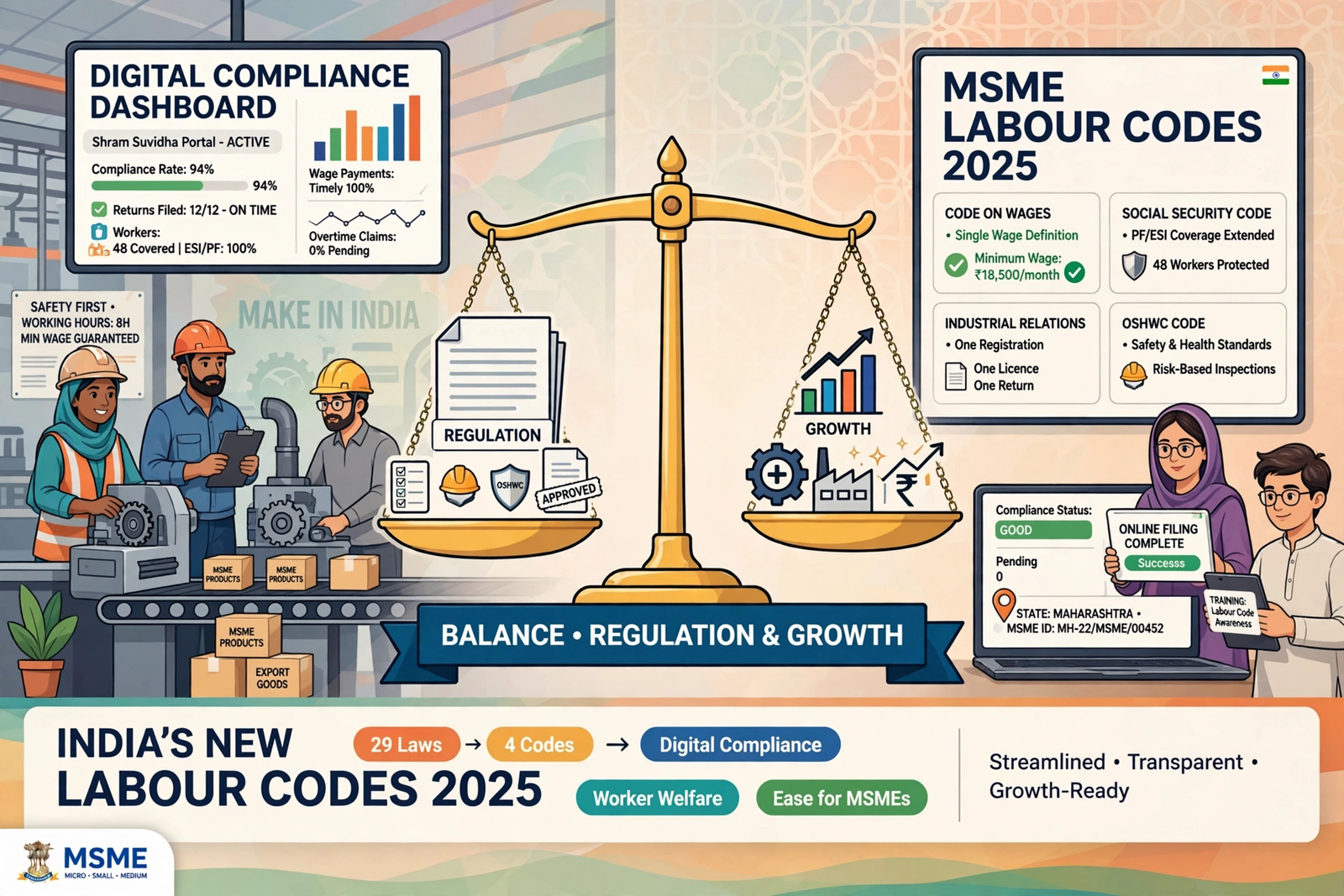
India has combined 29 labor laws into four new Labor Codes. These laws replace very old rules, some written in the 1930s. The Codes bring clear definitions and make compliance digital. They also provide social safety nets for all workers.
MSMEs employ more than 110 million people. They play a big role in India’s manufacturing sector. For them, the new Codes bring two main changes. They must follow higher compliance standards. At the same time, they gain more flexibility in contracts and scaling operations.
1. Four-Code Legal Framework
The structural consolidation integrates legacy laws into four primary frameworks designed to eliminate overlapping regulatory touchpoints and establish clear operational benchmarks across state lines.
| New Statutory Code | Consolidated Primary Statutes | Primary Focus for MSMEs | Key Structural Benchmark |
| Code on Wages, 2019 | Minimum Wages Act (1948), Payment of Wages Act (1936), Equal Remuneration Act (1976), Payment of Bonus Act (1965) | Unified definition of ‘Wages’, statutory Floor Wage, timely wage disbursements. | Allowances capped at 50% of total remuneration package. |
| Industrial Relations (IR) Code, 2020 | Industrial Disputes Act (1947), Trade Unions Act (1926), Industrial Employment (Standing Orders) Act (1946) | Raising thresholds for standing orders and closure permissions; formalizing Fixed-Term Employment (FTE). | Threshold for government approval on retrenchment/lay-offs raised from 100 to 300 workers. |
| Code on Social Security (2020) | EPF Act (1952), ESI Act (1948), Payment of Gratuity Act (1972), Maternity Benefit Act (1961), Unorganised Workers’ Social Security Act | Universal social protection, pro-rata gratuity for FTEs, registration of gig/platform & contract workers. | Pro-rata gratuity eligibility for Fixed-Term Employees set at 1 year (down from 5 years). |
| Occupational Safety, Health & Working Conditions (OSHWC) Code, 2020 | Factories Act (1948), Contract Labour Act (1970), Inter-State Migrant Workmen Act (1979), + 10 sector-specific acts | Standardizing work environments, single-window licensing, annual health checks, gender equality in shifts. | Factories Act threshold raised to 20 workers (with power) and 40 (without power). |
2. Key Impact Areas for Small Manufacturing Units
2.1 ‘50% Wage Rule’ and Payroll Restructuring
Historically, many small industrial units structured employee remuneration packages with a low basic salary (often 20% to 30% of Total Cost to Company / CTC) and inflated non-statutory allowances to minimize statutory Provident Fund (PF) and Gratuity liability. Under the new unified definition across all four Codes, basic pay plus dearness allowance and retaining allowance must comprise at least 50% of total remuneration. If allowances exceed 50%, the excess is automatically added back to the wage pool for calculating PF, ESI, Gratuity, and leave encashment.
| Statutory Wage Rule: Basic Pay + Dearness Allowance (DA) + Retaining Allowance ≥ 50% of Total Remuneration Package |
2.2 Operational Agility via Fixed-Term Employment (FTE)
Before the reform:
When orders spiked seasonally, MSMEs like textile units, export houses, and auto-component makers had to depend on informal contract workers hired through third-party contractors.
After the reform:
The new IR Code introduces Fixed-Term Employment (FTE) — a direct contract between you and the worker.
With FTE, the worker gets:
- Same benefits as a permanent worker doing the same job
- Gratuity after just 1 year of continuous service, on a pro-rata basis
No middleman, more transparency, and seasonal hiring becomes fully formal and compliant.
2.3 Ease of Operations vs. Enhanced Safety Obligations
The thresholds triggering major regulatory frameworks have shifted significantly. The Standing Orders and government approval threshold for retrenchment or closure raised from 100 to 300 workers. Similarly, the threshold for the Factories Act has increased from 10 to 20 workers (with power) and 20 to 40 workers (without power). However, shopfloor compliance rules have tightened with mandatory written appointment letters, annual free health checks for workers above 40, and prescribed safety standards for women working night shifts.
| Regulatory Area | Legacy Legal Threshold | New Labor Code Threshold |
| Retrenchment / Lay-off / Closure Approval | Establishments with 100 or more workers | Establishments with 300 or more workers |
| Factories Act Applicability | 10 workers (with power) / 20 (without power) | 20 workers (with power) / 40 (without power) |
| Contract Labour Act Applicability | 20 or more contract workers | 50 or more contract workers |
3. Strategic Compliance Roadmap for MSMEs
- Conduct a Payroll Financial Impact Analysis: Audit all current employment contracts. Model the cash-flow impact of adjusting the 50% basic wage cap on future gratuity accruals and monthly PF matching contributions.
- Standardize Fixed-Term Contracts: Transition reliance away from unorganized manpower agencies toward direct FTE contracts. Ensure contract durations mirror client delivery schedules and product cycle timelines.
- Migrate to Digital Portal Compliance: Leverage the unified web-based reporting tools. The traditional ‘Inspector Raj’ is replaced by an Inspector-cum-Facilitator system featuring web-based, randomized inspections to lower physical inspection friction.
4. Key Takeaways
- Universal Wage Standardization: The statutory floor wage guarantees nationwide wage protection and mandates overtime pay at twice the regular hourly rate, regardless of worker designation.
- Rebalanced Pay Structures: The mandatory 50% wage definition prevents baseline wage dilution, securing worker retirement benefits while requiring businesses to recalculate statutory liabilities.
- Direct Hiring Flexibility: Fixed-Term Employment allows seasonal units to scale workforce levels up or down based on actual demand without relying on middleman contractors.
- Higher Structural Thresholds: Raising the Standing Orders threshold to 300 workers gives mid-sized manufacturing units operational freedom to expand operations without seeking pre-approval for minor layoffs or operational restructuring.
- Simplified Single-Window Compliance: Multi-layered registers, physical inspections, and separate licenses are replaced by single registrations, unified annual returns, and digitized, transparent inspection mechanisms.
References & Legal Statutes
Ministry of Labour and Employment, Government of India. (2019). The Code on Wages, 2019 (No. 29 of 2019). The Gazette of India.
Ministry of Labour and Employment, Government of India. (2020). The Industrial Relations Code, 2020 (No. 35 of 2020). The Gazette of India.
Ministry of Labour and Employment, Government of India. (2020). The Code on Social Security, 2020 (No. 36 of 2020). The Gazette of India.
Ministry of Labour and Employment, Government of India. (2020). The Occupational Safety, Health and Working Conditions Code, 2020 (No. 37 of 2020). The Gazette of India.
Press Information Bureau (PIB), Government of India. (2021). Key Reforms under New Labour Codes for Ease of Doing Business and Worker Welfare. Ministry of Labour & Employment.
International Labour Organization (ILO). (2022). India Wage Report: Wage policies and inequality in India. ILO Decent Work Team for South Asia.
V.V. Giri National Labour Institute. (2021). Labour Code Reforms in India: Implications for MSMEs and Informal Sector Employment. Research Report Series.
Standing Committee on Labour. (2020). Report on the Industrial Relations Code, 2019 & Code on Social Security, 2020. Lok Sabha Secretariat, New Delhi.
Author Profile

-
Gladstone Leslie Samuel has over 35 years of experience in chemical process industries, research and development, and management, having worked with ABB, Invensys, Baan, IDC, and SPIC.
He holds a B.Tech in Chemical Engineering, an MBA in Information Technology, and an MA in Journalism and Mass Communication. He is also a Certified Independent Director (MCA), Certified ESG Professional (CII), and Project Management Professional (PMP).
He serves as an external board member, advisor, guest faculty member, and industry mentor. His areas of work include stakeholder management, risk mitigation, corporate social responsibility, and ESG. He is the author of Corporate Governance in Indian Startups: Navigating Compliance and Growth.