





The global digital economy is undergoing a fundamental transformation as individuals increasingly monetize their creativity, expertise, and intellectual property through dedicated digital platforms. According to the latest Creator Economy Platform Market report published by Growth Market Reports, the sector is entering a new phase of sustained expansion, driven by rapid advances in artificial intelligence (AI), growing digital entrepreneurship, rising demand for subscription-based content, and the proliferation of creator-focused monetization platforms. The report presents a comprehensive assessment of market size, emerging trends, growth drivers, competitive dynamics, regional developments, and future opportunities shaping the creator economy ecosystem. It estimates that the global Creator Economy Platform Market reached USD 26.7 billion in 2025 and is projected to grow to USD 105.6 billion by 2034, registering a robust compound annual growth rate (CAGR) of 17.4% during the forecast period. These projections underscore the increasing importance of creator economy platforms as essential infrastructure supporting digital entrepreneurship, knowledge commerce, and direct creator-to-consumer engagement worldwide.
The Evolution of the Creator Economy
The creator economy has evolved from a niche segment dominated by social media influencers into a major pillar of the digital economy. Today, millions of educators, writers, artists, musicians, consultants, software developers, podcasters, gamers, coaches, and entrepreneurs are building independent businesses by creating and distributing digital content.
Unlike earlier digital business models that relied primarily on advertising revenue, today’s creators increasingly generate income through subscriptions, memberships, online courses, digital products, consulting services, newsletters, podcasts, and community-based platforms. This transition reflects a broader economic shift towards creator ownership, recurring revenue models, and direct customer relationships.
Creator economy platforms provide the technological foundation that enables creators to manage content, engage audiences, process payments, analyse performance, and scale their businesses without relying exclusively on traditional media organizations or algorithm-driven social media platforms.
Understanding Creator Economy Platforms
A creator economy platform is an integrated digital solution that enables individuals and organizations to create, distribute, manage, and monetize original content while maintaining direct relationships with their audiences.
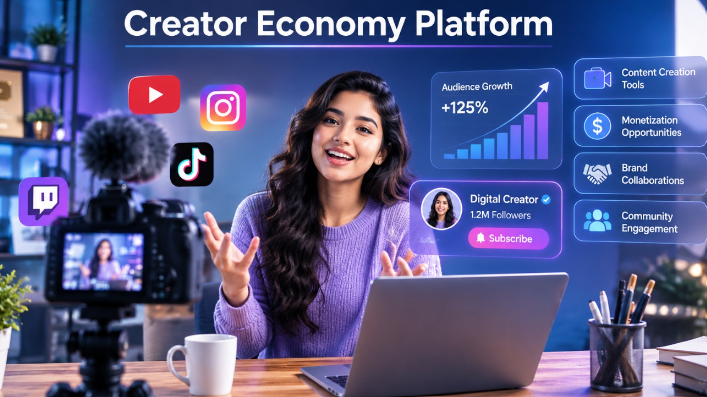
Modern platforms typically combine multiple business functions within a single ecosystem, including:
- Content publishing
- Digital storefronts
- Subscription and membership management
- Payment processing
- Customer relationship management (CRM)
- Audience analytics
- Email marketing automation
- Community-building tools
- Affiliate marketing capabilities
- Live streaming
- AI-powered content assistance
Rather than functioning merely as publishing tools, these platforms increasingly serve as comprehensive operating systems for digital entrepreneurs.
Key Drivers Behind Market Expansion
Several structural developments are accelerating the growth of the creator economy platform market.
Digital Entrepreneurship
Across industries, professionals are transforming their specialized knowledge into commercial digital assets. Whether through educational content, business consulting, coaching, research publications, online learning, or creative media, individuals increasingly view digital entrepreneurship as a viable long-term career path.
The relatively low capital requirements associated with digital businesses have lowered barriers to entry, enabling entrepreneurs from diverse economic backgrounds to participate in global markets.
Changing Consumer Preferences
Consumers are increasingly willing to pay directly for valuable content and personalized experiences. Subscription-based memberships, premium communities, exclusive newsletters, online academies, and specialized educational resources provide creators with predictable revenue while strengthening customer loyalty.
This transition from advertising-dependent income to direct monetization has become one of the defining characteristics of the modern creator economy.
Artificial Intelligence as a Growth Catalyst
Artificial intelligence has rapidly become one of the most influential technologies within the creator ecosystem.
AI-powered tools now assist creators in research, writing, image generation, video editing, multilingual translation, search engine optimization, audience analytics, marketing automation, and customer engagement.
Rather than replacing human creativity, AI increasingly functions as a productivity partner, allowing creators to produce professional-quality content with greater efficiency while reducing operational costs. This democratization of advanced production capabilities enables independent creators to compete with much larger media organizations.
Digital Payments and Global Accessibility
Improvements in global digital payment systems have significantly expanded opportunities for cross-border entrepreneurship.
Creators can now receive payments from international audiences through integrated payment gateways, reducing transaction barriers and enabling global commerce. Combined with widespread smartphone adoption and affordable internet access, these developments are supporting the rapid international expansion of the creator economy.
The Shift from Content Creation to Business Ownership
One of the most significant developments within the creator economy is the transformation of creators into business owners.
In earlier years, many creators depended heavily on advertising revenues controlled by large social media platforms. Changes in algorithms or monetization policies often resulted in unpredictable income.
Today’s creator economy places greater emphasis on ownership. Independent websites, digital storefronts, membership communities, podcasts, newsletters, online courses, and proprietary customer databases enable creators to build sustainable enterprises based on long-term customer relationships rather than short-term platform visibility.
This evolution reflects a broader movement toward digital independence and entrepreneurial resilience.
Community as a Competitive Advantage
The most successful creator businesses increasingly focus on building engaged communities rather than simply attracting large audiences.
Interactive discussions, live events, collaborative learning environments, member-exclusive resources, networking opportunities, and personalized engagement create stronger customer loyalty and higher retention rates.
Community-driven business models also generate valuable feedback that helps creators continuously improve products and services while strengthening long-term relationships with their audiences. Platforms capable of integrating community engagement alongside content delivery are expected to maintain significant competitive advantages.
Regional Expansion
Although North America remains one of the largest markets for creator economy platforms, adoption is expanding rapidly across Asia-Pacific, Europe, Latin America, the Middle East, and Africa.
Several structural factors support this growth:
- Increasing smartphone penetration
- Expansion of affordable broadband connectivity
- Growth in freelance employment
- Rising demand for online education
- Expansion of multilingual content
- Cross-border digital commerce
- Remote work adoption
- Improved digital payment infrastructure
Emerging economies are producing millions of first-generation digital entrepreneurs capable of serving global audiences without significant physical infrastructure investment.
Challenges Facing the Industry
Despite its impressive growth trajectory, the creator economy platform market faces several important challenges.
Growing competition among platform providers requires continuous innovation and differentiation. Increasing regulatory scrutiny concerning data privacy, cybersecurity, and digital governance necessitates ongoing compliance investments.
Artificial intelligence also raises important questions regarding content authenticity, copyright protection, misinformation, and ethical use of AI-generated media.
Furthermore, income sustainability continues to vary considerably across creator categories, depending upon audience engagement, market specialization, and evolving platform economics. Balancing creator freedom with responsible content moderation remains an ongoing challenge for platform operators worldwide.
Emerging Trends
Several technological and business innovations are expected to shape the future of the creator economy.
Artificial intelligence will increasingly enable personalized recommendations, intelligent workflow automation, customized learning experiences, and predictive audience analytics.
Blockchain technologies may improve digital ownership verification and intellectual property protection, while virtual reality (VR) and augmented reality (AR) are expected to create immersive educational, entertainment, and commercial experiences.
Highly specialized micro-communities are likely to outperform generalized audiences in both engagement and monetization.
Future creator platforms may also integrate financial services such as invoicing, taxation support, insurance, banking, investment management, and business financing, transforming them into comprehensive digital enterprise ecosystems.
Future Outlook
According to Growth Market Reports, the Creator Economy Platform Market is entering a new phase where technology, entrepreneurship, and community-building converge to redefine how value is created online. As artificial intelligence, subscription commerce, digital ownership, and global connectivity continue to mature, creators will increasingly operate as independent enterprises rather than traditional content producers. Platforms that combine intelligent automation, flexible monetization, audience ownership, security, and seamless user experiences will shape the next generation of digital innovation. Over the coming decade, the creator economy is expected to become a foundational pillar of the global digital economy, empowering individuals from every region to build scalable, resilient, and internationally connected businesses through creativity and knowledge.
The creator economy has evolved beyond social media into a sophisticated ecosystem that combines technology, entrepreneurship, commerce, and community. Creator economy platforms are becoming the digital infrastructure through which millions of individuals build sustainable businesses based on knowledge, creativity, and innovation.
As artificial intelligence continues to lower production barriers and digital commerce expands globally, the creator economy is likely to play an increasingly significant role in employment generation, innovation, education, and economic development. For entrepreneurs, investors, technology companies, and policymakers alike, understanding the dynamics of this rapidly evolving market will be essential in shaping the future of the global digital economy.
Author Profile
Latest entries
 Entreprenurs7 August 2026More Enabling Digital Regulations Could Add ₩2.4 Trillion (US$1.73 Billion) in Annual VC Investment for South Korean Startups: Oxford Economics
 AI24 July 2026The Creator Economy Platform Market: AI, Digital Entrepreneurship, and the Future of Online Business
 FEATURED9 July 2026Bluevine Expands U.S. Business Banking Solutions to India-Based Entrepreneurs
 FEATURED2 April 2026Parametric Weather Insurance Emerges as a Strategic Risk Instrument for SMEs Amid Rising Climate Volatility