





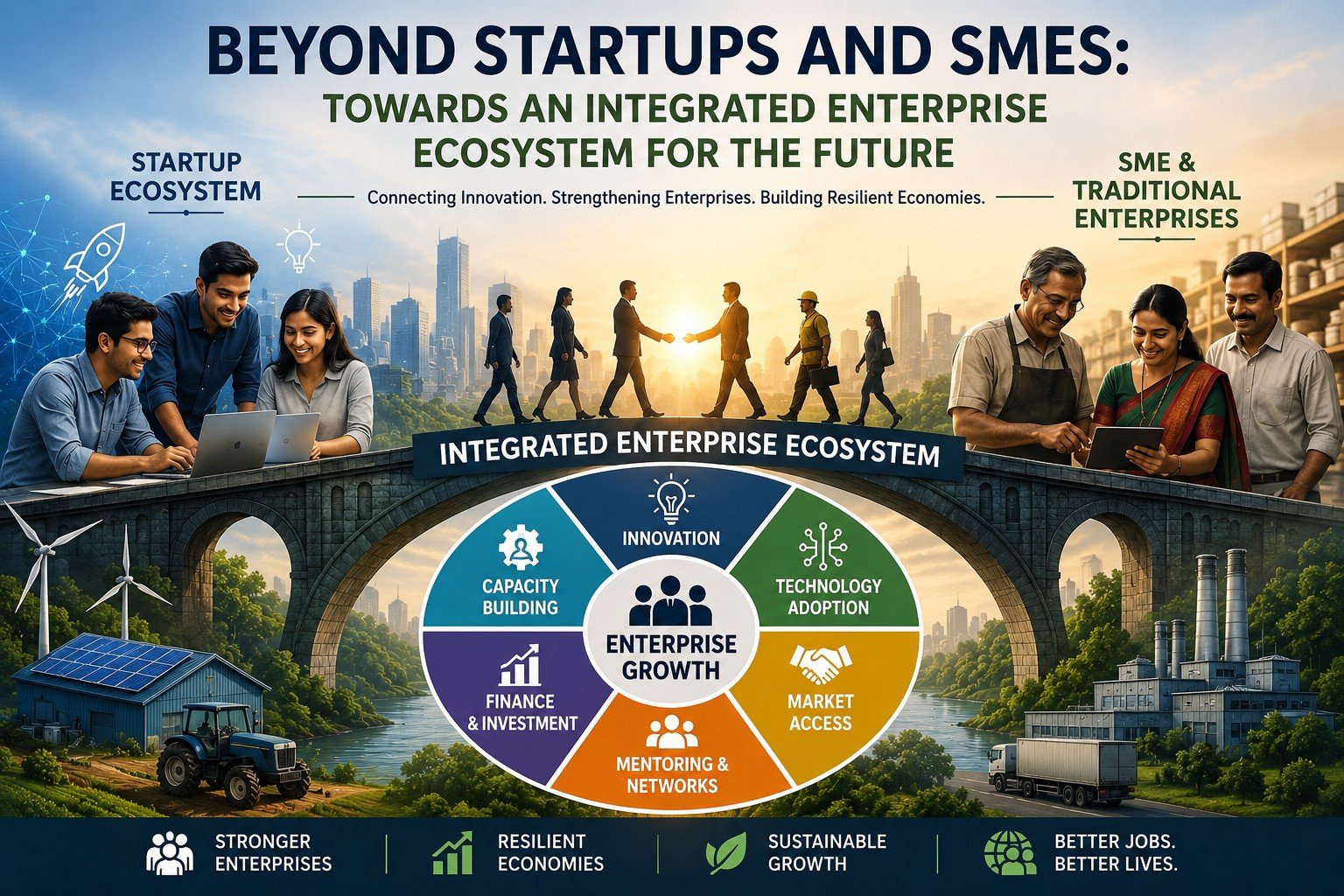
The future of enterprise development requires moving beyond the traditional divide between startups and SMEs. As business models evolve, innovation is emerging from both new ventures and established enterprises. Building integrated enterprise ecosystems that combine experience, technology, finance, mentoring, and innovation capabilities can unlock new opportunities for growth, competitiveness, employment, and sustainable economic transformation.
Over the last decade, the startup revolution has transformed the way economies think about entrepreneurship. Across countries, new firms have benefited from a rapidly expanding ecosystem of incubators, accelerators, innovation platforms, mentoring networks, investors, and policy support. These initiatives have created new entrepreneurial energy, encouraged experimentation, and placed innovation at the centre of economic development strategies.
At the same time, millions of existing small enterprises, family businesses, agro-processing firms, traditional manufacturers, and service enterprises continue to form the productive foundation of economies. They generate employment, sustain supply chains, preserve traditional skills, support local communities, and create economic value across regions.
Their contribution extends beyond business numbers. Existing enterprises provide stable employment, enable intergenerational knowledge transfer, strengthen regional economies, and often create social value through long-term relationships with workers, suppliers, and communities. They represent accumulated experience, operational capabilities, and market knowledge developed over many years.
This raises an important question for the next phase of enterprise development: should startups and existing enterprises continue to be supported through largely separate systems, or is it time to build a more integrated enterprise ecosystem?
The next wave of transformation may not come only from creating new firms. It may also emerge from strengthening, modernising, and unlocking the vast potential of enterprises that already exist. Technology adoption and enterprise transformation increasingly enable traditional firms to develop many of the characteristics commonly associated with startups — including innovation, agility, experimentation, and responsiveness to changing markets.
Bridging Two Enterprise Development Traditions
For decades, enterprise development policies have evolved through two parallel approaches.
SME support systems have focused largely on improving existing businesses through finance, training, infrastructure support, technology upgrading, market assistance, and institutional development.
Startup ecosystems, on the other hand, have developed around incubation, acceleration, mentoring, innovation networks, technology partnerships, and new forms of investment.
Both approaches have created significant value. The issue is not the absence of support for SMEs. Many countries already have extensive institutions and programmes for small enterprise development. The larger question is whether these two systems should continue operating separately when the nature of enterprises themselves is changing.
| Area | Existing SME Support Architecture | Startup Ecosystem Architecture |
| Institutional Platforms | SME agencies, chambers, industry associations, government departments | Incubators, accelerators, innovation hubs, startup missions, venture studios |
| Finance Mechanisms | Bank loans, credit guarantees, subsidies, working capital finance, government schemes | Seed funding, angel investment, venture capital, innovation grants, accelerator funding |
| Capacity Building | Entrepreneurship training, skill development programmes, business workshops | Founder mentoring, expert networks, strategic coaching, peer communities |
| Technology Support | Technology upgrading schemes, machinery support, digital adoption programmes | Product development labs, technology partnerships, R&D networks, innovation platforms |
| Market Access | Trade fairs, buyer-seller programmes, export promotion initiatives | Demo days, investor networks, global platforms, ecosystem partnerships |
| Knowledge Networks | Consultants, industry bodies, training institutions | Mentors, entrepreneurs-in-residence, investors, universities, innovation communities |
| Growth Approach | Productivity improvement, expansion, operational strengthening | Experimentation, scaling, business model innovation |
| Measurement Focus | Enterprises assisted, loans provided, training participation, employment supported | Investment raised, market growth, innovation outcomes, scaling potential |
The comparison shows that the difference is not between supported and unsupported enterprises. Rather, it reflects two different approaches to enterprise development.
Traditional SME systems were largely created to help businesses overcome constraints. Startup ecosystems were designed to surround entrepreneurs with networks, knowledge, finance, technology, and opportunities for experimentation.
However, this separation is increasingly becoming outdated.
The Emerging Hybrid Enterprise Reality
Many young enterprises are increasingly adopting characteristics historically associated with successful family businesses, including steady growth approaches, trust-based relationships, operational discipline, and a long-term commitment to customers and markets. At the same time, many established enterprises are demonstrating startup-like behaviour through digital adoption, product innovation, market experimentation, and adaptation to changing consumer expectations.
The emerging reality is that innovation is no longer determined by the age of an enterprise.
A food-processing company developing new products, an agro-enterprise adopting digital supply systems, a traditional manufacturer redesigning processes, or a family enterprise entering new markets may demonstrate the same entrepreneurial capabilities expected from startups.
The future therefore should not be about simply extending startup models to SMEs or converting existing enterprises into startups. The next stage should be the creation of integrated enterprise ecosystems that combine the strengths of both traditions.
| Strengths from SME Systems | Strengths from Startup Ecosystems | Integrated Enterprise Ecosystem Approach |
| Credit access and financial stability | Risk capital and innovation finance | Diverse financing models based on enterprise needs |
| Practical business experience | Innovation and experimentation culture | Experience-driven innovation |
| Training and capacity building | Mentoring and ecosystem networks | Continuous enterprise capability development |
| Existing customers and markets | Market discovery and rapid validation | Market expansion and renewal |
| Operational knowledge | New technologies and digital tools | Technology-enabled transformation |
| Long-term business relationships | Fast adaptation and scaling methods | Sustainable competitiveness |
Such an integrated approach can generate wider economic and social benefits. When an existing enterprise transforms through better technology adoption, improved management systems, stronger market access, and higher productivity, the impact extends beyond the entrepreneur.
It contributes to better jobs, improved incomes, resilient supply chains, stronger communities, and an improved quality of life.
The future enterprise landscape will increasingly be shaped by organisations that combine innovation with resilience. Enterprise policy must therefore move beyond conventional classifications and recognise a changing reality: enterprises increasingly succeed by combining experience, adaptability, and innovation.
The defining question should not simply be whether an enterprise is new or established. The more important question is whether it has the vision and capability to innovate, adapt, create value, and respond to emerging economic opportunities.
The economies of the future may depend not only on the enterprises we create tomorrow, but also on our ability to transform and empower the millions of enterprises that already exist today.
Author Profile

-
Dr. Perumal Koshy is associated with the Enterprise Futures Lab and is a columnist focused on institutional governance and economic systems. He writes on MSMEs, enterprise development, and policy issues affecting small business ecosystems.
Linkedin: https://www.linkedin.com/in/caushie/
Latest entries
 FEATURED18 July 2026The New Generation of FTAs: Why Services Are Replacing Tariffs as the Main Trade Issue
 FEATURED11 July 2026Beyond Startup Disruption: Why Innovation Must Strengthen Industrial Ecosystems, Not Weaken Them
 FEATURED13 June 2026Beyond Startups and SMEs: Towards an Integrated Enterprise Ecosystem for the Future
 ESG6 June 2026The Scale Obsession: When Institutions Become Bigger Than Their Purpose