




Free Trade Agreements (FTAs) have traditionally been associated with tariff liberalisation and improved market access for goods. For several decades, trade negotiations largely focused on reducing customs duties, eliminating quantitative restrictions and facilitating merchandise trade. The success of an agreement was often measured by the extent to which it lowered tariffs and expanded opportunities for exporters and importers.
However, the priorities of international trade negotiations are undergoing a significant transformation. While tariff liberalisation continues to remain an important element of trade agreements, particularly in sectors such as agriculture, manufacturing and automobiles, contemporary FTAs increasingly address issues relating to services, digital trade, investment facilitation, regulatory cooperation, professional mobility and data governance. This transition reflects broader structural changes in the global economy, where knowledge-intensive activities and digitally enabled services are contributing an expanding share of economic output and international trade.
The recently implemented India–United Kingdom Comprehensive Economic and Trade Agreement (CETA), together with the United Kingdom–Switzerland Enhanced Trade Partnership and the growing number of Digital Economy Agreements (DEAs), illustrates this changing orientation. These agreements extend well beyond conventional tariff concessions and seek to establish common frameworks for digital commerce, cross-border services, regulatory cooperation and the temporary movement of professionals. Such developments indicate that modern trade policy is increasingly concerned with facilitating the movement of knowledge, technology and services alongside the movement of goods.
From Tariff Liberalisation to Regulatory Cooperation
The declining prominence of tariffs in trade negotiations is largely the result of successive rounds of trade liberalisation undertaken over the past three decades. Negotiations under the General Agreement on Tariffs and Trade (GATT), followed by the establishment of the World Trade Organization (WTO), together with numerous bilateral and regional trade agreements, have significantly reduced average tariff levels across many sectors of the global economy.
Consequently, businesses today frequently encounter greater challenges from non-tariff measures than from customs duties. Differences in technical standards, product certification procedures, licensing requirements, digital regulations, customs documentation and regulatory compliance often impose higher costs on businesses seeking access to international markets. As a result, recent FTAs increasingly emphasise regulatory cooperation, transparency, trade facilitation and institutional coordination as mechanisms for reducing the cost of doing business across borders.
Services and the Changing Structure of International Trade
The increasing importance of services represents one of the most significant structural developments in the global economy. According to the World Trade Organization (WTO) and the Organisation for Economic Co-operation and Development (OECD), services account for approximately two-thirds of global GDP and constitute a major source of employment and productivity growth in many economies.
Equally important is the growing integration of services within manufacturing itself. Modern industrial production increasingly incorporates software, engineering design, logistics, cloud computing, research and development, financial services and after-sales technical support. Consequently, the distinction between goods and services has become progressively less pronounced. In many industries, the competitiveness of manufactured products depends as much on associated services as on the physical product itself.
This structural transformation explains why services have become central to contemporary trade negotiations. Liberalisation of services increasingly complements merchandise trade by supporting global value chains and facilitating greater participation in international production networks.
Digital Trade as a New Priority
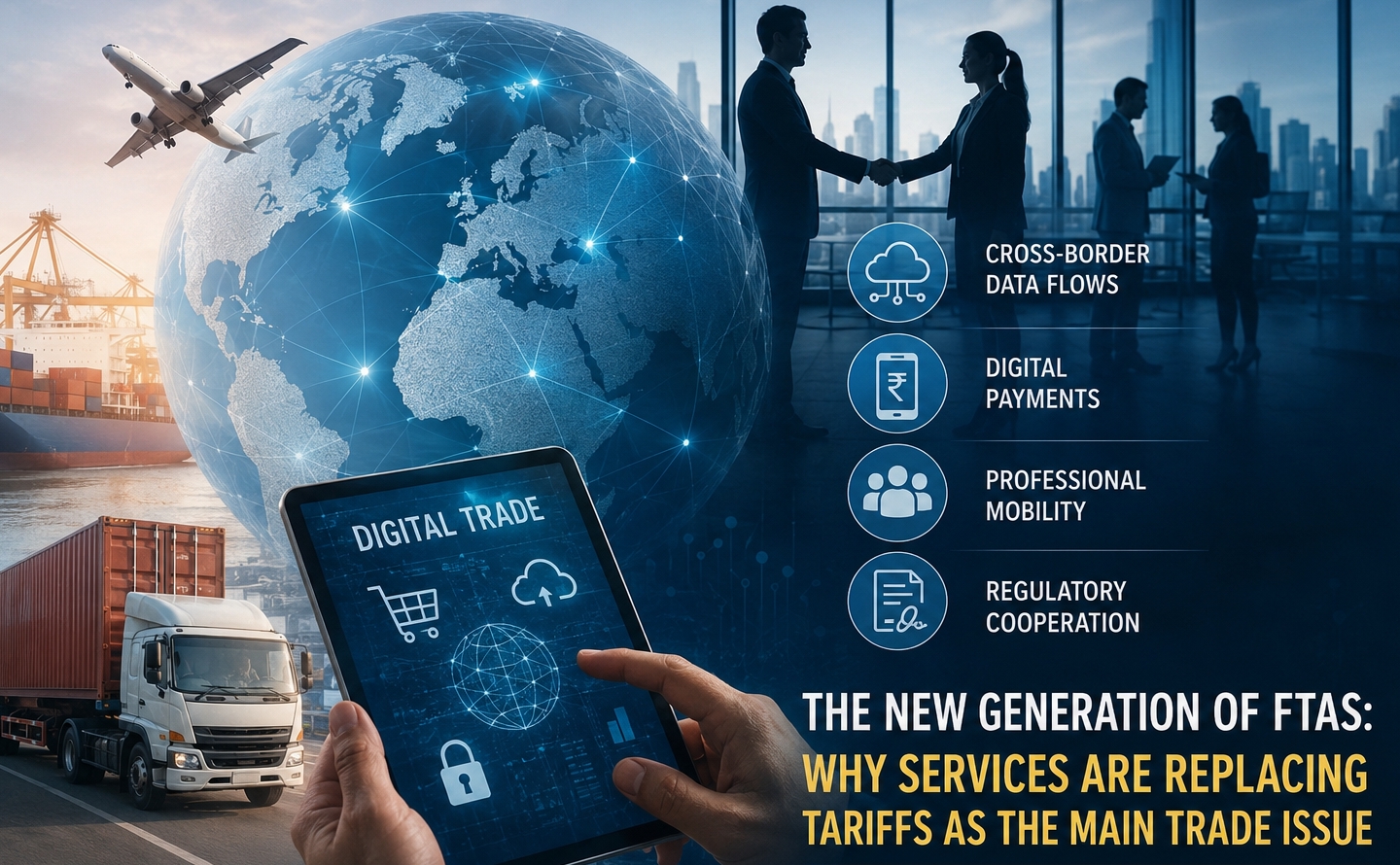
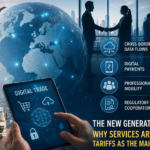
Another defining characteristic of the new generation of FTAs is the growing emphasis on digital trade. Recent agreements increasingly incorporate provisions relating to cross-border data flows, electronic commerce, digital authentication, consumer protection, cybersecurity cooperation and emerging issues associated with artificial intelligence.
These provisions are becoming particularly relevant for micro, small and medium enterprises (MSMEs). Digital platforms have enabled smaller firms to participate in international markets through software development, consulting, online education, design services, digital marketing and other knowledge-based activities without necessarily establishing a physical presence in overseas markets.
For such enterprises, regulatory certainty regarding digital transactions, data flows and electronic commerce may generate greater commercial opportunities than conventional tariff reductions alone. Consequently, digital trade chapters are becoming an increasingly important component of contemporary trade agreements.
Professional Mobility and Cross-Border Service Delivery
The expansion of services trade has also increased the importance of professional mobility within trade agreements. Temporary movement of engineers, architects, consultants, financial professionals, technology specialists and other skilled personnel has become essential for delivering many cross-border services.
Recent agreements increasingly seek to simplify procedures governing temporary business travel, recognition of professional qualifications and social security arrangements. These provisions facilitate international collaboration while reducing administrative barriers faced by businesses operating across multiple jurisdictions.
Professional mobility therefore represents an increasingly important dimension of international competitiveness, particularly in sectors characterised by knowledge-intensive activities and specialised technical services.
Implications for SMEs
The changing nature of FTAs presents both opportunities and challenges for SMEs. Traditionally, larger corporations have been better positioned to benefit from international trade agreements because of their greater financial and administrative resources. However, digitalisation has enabled many smaller enterprises to participate directly in international markets.
Nevertheless, several challenges continue to constrain SME participation. Compliance with rules of origin, product standards, certification requirements, customs procedures and regulatory obligations often requires specialised knowledge and institutional support. Studies undertaken by the OECD and the International Trade Centre (ITC) indicate that utilisation rates of preferential trade agreements remain relatively low among SMEs despite the availability of market access opportunities.
This suggests that the effectiveness of contemporary FTAs depends not only upon the provisions negotiated between governments but also upon the capacity of enterprises to understand and utilise those provisions effectively.
Looking Ahead
The evolution of Free Trade Agreements reflects the changing character of the global economy. Although tariff liberalisation continues to remain relevant, particularly in selected sectors, contemporary trade negotiations increasingly recognise that competitiveness is determined by a broader range of factors, including services, digital infrastructure, regulatory coherence, investment facilitation and professional mobility.
For policymakers, the principal challenge lies in ensuring that these agreements remain accessible and relevant to businesses of all sizes. Greater attention will need to be directed towards implementation, institutional coordination, digital trade facilitation and capacity building, particularly for SMEs that often face resource constraints in complying with international trade requirements.
The future success of FTAs will therefore be assessed not solely by the extent of tariff reductions achieved, but by their ability to facilitate seamless participation in an increasingly digital, knowledge-based and interconnected global economy. For SMEs, this transformation offers significant opportunities, provided that appropriate policy support, regulatory clarity and institutional mechanisms are put in place to enable their effective participation in international trade.
Author Profile

-
Dr. Perumal Koshy is associated with the Enterprise Futures Lab and is a columnist focused on institutional governance and economic systems. He writes on MSMEs, enterprise development, and policy issues affecting small business ecosystems.
Linkedin: https://www.linkedin.com/in/caushie/
Latest entries
 FEATURED18 July 2026The New Generation of FTAs: Why Services Are Replacing Tariffs as the Main Trade Issue
 FEATURED11 July 2026Beyond Startup Disruption: Why Innovation Must Strengthen Industrial Ecosystems, Not Weaken Them
 FEATURED13 June 2026Beyond Startups and SMEs: Towards an Integrated Enterprise Ecosystem for the Future
 ESG6 June 2026The Scale Obsession: When Institutions Become Bigger Than Their Purpose