


The growing tendency to equate disruption with innovation is reshaping economic policy and investment priorities. While technological progress remains essential, disruption-led growth can weaken SMEs, employment, and productive sectors when pursued as an end in itself. Sustainable innovation must expand productive capacity, strengthen enterprise ecosystems, and generate long-term economic resilience rather than merely accelerating market displacement.
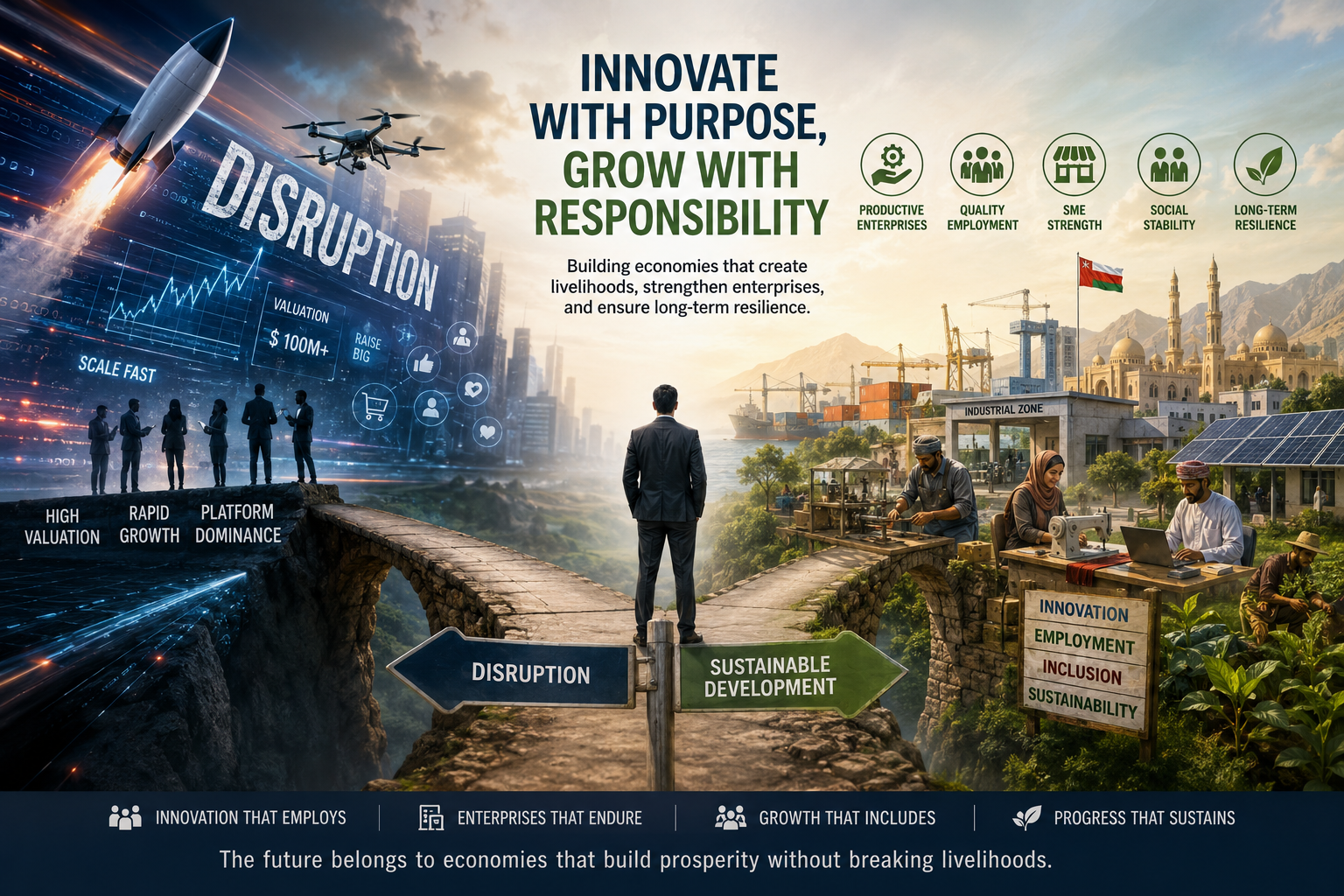
A prevailing narrative has conditioned markets to believe that the faster a startup disrupts an industry, the more innovative it is. Yet, this obsession with rapid scaling risks fracturing long-term economic foundations.
Across many economies, disruption-oriented startup culture has increasingly become the dominant framework through which innovation is evaluated and funded.
Governments celebrate startup ecosystems, investors chase rapid scalability, and technology platforms are presented as symbols of modernization and future readiness. In this narrative, the faster a company disrupts existing structures, the more innovative it is assumed to be.
Yet an important question is emerging across many economies: has disruption itself become the primary development model?
The Disruption Trap
Innovation remains essential for economic and technological advancement. However, much of today’s startup-focused innovation environment remains centered on rapid scaling, valuation-driven growth models, and platform concentration rather than broader developmental outcomes.
This distinction between innovation and disruption is becoming economically significant.
In many startup environments, success is measured by speed of scaling, market dominance, and investor interest. Far less attention is paid to employment generation, manufacturing linkages, or long-term livelihood sustainability.
The Reality of Livelihood Sustainability
While new firms contribute to economic dynamism, established SMEs continue to sustain the bulk of long-term employment. In the European Union, SMEs account for roughly two-thirds of private-sector employment. In Oman, micro, small, and medium enterprises accounting for a substantial share of private-sector employment according to recent national estimates.
Startup mortality rates also remain high globally, with many ventures failing within their first few years despite substantial investment inflows. Even successful firms often achieve very high valuations with relatively modest direct employment compared to traditional productive sectors.
This trend carries serious implications for economies like Oman, where large segments of the population depend on microenterprises, SMEs, local retail, artisanal production, and labor-intensive activities. In such contexts, disruption is not merely a technological event — it directly affects household incomes, regional employment structures, local businesses, and social stability.
The core challenge is not technological advancement itself, but the growing absence of policy frameworks capable of distinguishing socially productive innovation from disruption-led expansion.
Many socially valuable innovations — in green technologies, healthcare, agriculture, and community development — require patient capital, phased integration, institutional support, and long-term developmental orientation rather than rapid monetization or venture-capital acceleration.
This creates a structural imbalance: technological expansion is increasingly becoming disconnected from employment and productive economic activity.
Global Lessons in Productive Resilience
Historically, successful economic transformations occurred when innovation remained closely linked to manufacturing capability, workforce development, and productive enterprises. Germany’s industrial strength evolved through strong coordination between engineering capability, vocational training, SME networks, and advanced manufacturing systems. Italy’s industrial districts developed through territorially embedded SME structures where innovation remained connected to local production and artisanal specialization. East Asian economies such as Japan and South Korea achieved sustained modernization through gradual technological integration and manufacturing expansion.
Oman’s experience offers a valuable contemporary example. The Sultanate’s diversification under Oman Vision 2040 has generally followed a gradual and employment-sensitive approach. Rather than relying primarily on venture-capital-driven digital startup models, it emphasizes linking innovation with logistics, manufacturing, tourism, fisheries, infrastructure development, and SME promotion within a broader state-guided framework.
Economic initiatives linked to the Duqm Special Economic Zone, Port of Sohar, Port of Salalah, and industrial free zones reflect this commitment to productive-sector integration.
Toward a Responsible Framework for Growth
Future innovation policy cannot focus exclusively on scalability and disruption metrics. It must increasingly evaluate whether innovation strengthens productive capacity, generates quality employment, supports enterprise development, and contributes to social stability.
The coming decade may require more responsible forms of innovation governance — including employment-impact assessments for emerging technologies, phased deployment mechanisms for automation, transition support for workers, and stronger integration between startups and productive sectors.
True sustainability cannot be defined by technological advancement alone. An economy cannot be considered sustainable if modernization weakens livelihoods, destabilizes local enterprises, and deepens economic insecurity. Genuine sustainability must also include employment continuity, productive resilience, and socially balanced transition management.
The defining policy question of the future may therefore not be how rapidly one would innovate, but whether they modernize without weakening the productive foundations upon which millions of livelihoods depend. The future will likely belong to economies that align innovation with industrial capability, employment stability, and long-term social resilience.
Author Profile

-
Dr. Perumal Koshy is associated with the Enterprise Futures Lab and is a columnist focused on institutional governance and economic systems. He writes on MSMEs, enterprise development, and policy issues affecting small business ecosystems.
Linkedin: https://www.linkedin.com/in/caushie/
Latest entries
 FEATURED18 July 2026The New Generation of FTAs: Why Services Are Replacing Tariffs as the Main Trade Issue
 FEATURED11 July 2026Beyond Startup Disruption: Why Innovation Must Strengthen Industrial Ecosystems, Not Weaken Them
 FEATURED13 June 2026Beyond Startups and SMEs: Towards an Integrated Enterprise Ecosystem for the Future
 ESG6 June 2026The Scale Obsession: When Institutions Become Bigger Than Their Purpose