


Skip to content
  • News
  • TOP STORIES
  • Enterprise
  • Reports
  • Technology
  • Opinion
  • Reviews
  • Videos
  • Digital issues
  • Issues & Archive
  • Contact

Global SME News

Smarter Markets, Stronger Economies: AI-Driven Deregulation for the Digital Age

  • News
  • TOP STORIES
  • Enterprise
  • Reports
  • Technology
  • Opinion
  • Reviews
  • Videos
  • Digital issues
  • Issues & Archive
  • Contact
  • Toggle search form
  • Birla Precision Technologies Unveils New Brand Identity to Accelerate Growth in High-Precision and Emerging Sectors
    Birla Precision Technologies Unveils New Brand Identity to Accelerate Growth in High-Precision and Emerging Sectors News
  • Post Budget 2026 | Real Estate: Stability, Infrastructure Momentum, and the Emergence of a Market-Driven Cycle
    Post Budget 2026 | Real Estate: Stability, Infrastructure Momentum, and the Emergence of a Market-Driven Cycle FEATURED
  • Outlook 2026 | Real Estate: Infrastructure-Led Growth, Integrated Communities, and the Trust Imperative
    Outlook 2026 | Real Estate: Infrastructure-Led Growth, Integrated Communities, and the Trust Imperative FEATURED
  • Scaling SMEs: Why Governance Matters as Much as Growth
    Scaling SMEs: Why Governance Matters as Much as Growth FEATURED
  • Quality, Crisis, and Consistency: The Rungta Tea Story
    Quality, Crisis, and Consistency: The Rungta Tea Story Entreprenurs
  • Strategic Storytelling for Startup/SME Founders
    Strategic Storytelling for Startup/SME Founders FEATURED
  • From Survival to Strategy: How MSMEs Are Redefining Growth in a Fragmented Global Economy
    From Survival to Strategy: How MSMEs Are Redefining Growth in a Fragmented Global Economy FEATURED
  • AI Data Center Networking Market: Building the Backbone of the AI-Driven Digital Economy
    AI Data Center Networking Market: Building the Backbone of the AI-Driven Digital Economy AI
What Startups Can Learn from Family Businesses—And Vice Versa

What Startups Can Learn from Family Businesses—And Vice Versa

Posted on 31 July 202531 July 2025 By Perumal Koshy No Comments on What Startups Can Learn from Family Businesses—And Vice Versa

Why Startups Aren’t the Only Face of Entrepreneurship

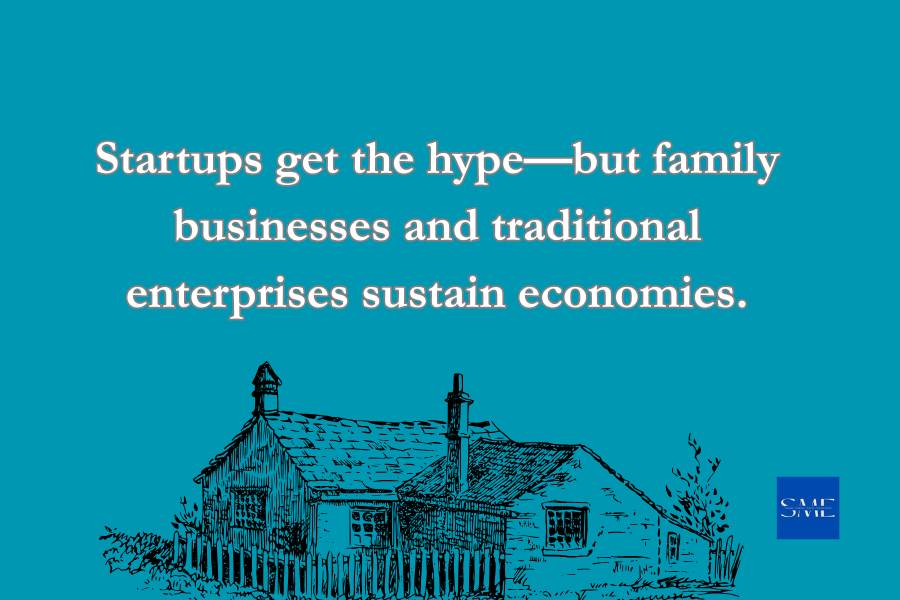
Startups drive innovation, but family businesses and traditional SMEs build resilience, trust, and long-term value. Understanding how these models complement each other is key to redefining entrepreneurship for real-world impact and sustainable economic growth.

The global fascination with startups—high-growth ventures chasing billion-dollar valuations—has reshaped how we view entrepreneurship. Yet startup culture is not the same as entrepreneurial culture. Equating the two narrows the lens through which we understand economic activity and enterprise-building. In India, across the Asia-Pacific, and beyond, startups often attract disproportionate attention, while other forms of enterprise—family-run businesses, local firms, and small manufacturers—remain integral but overlooked.

Startups continue to dominate discourse, but these enterprises account for a relatively modest share of employment. According to data from India’s Department for Promotion of Industry and Internal Trade (DPIIT), the country saw a growth from 452 registered startups in 2016 to over 84,000 by 2022. Yet the total direct jobs attributed to startups stand at around 1.6 million. In contrast, around 57 million Udyam-registered MSMEs reported employing close to 240 million people. 

Startups: High Visibility, High Risk

Startups are often associated with speed, innovation, and disruption, but face steep odds. According to the U.S. Bureau of Labor Statistics and similar regional studies, over 90% of startups globally fail, with nearly half not surviving beyond five years. Asia-Pacific and Indian markets reflect comparable trends—failure rates of around 70% or more in some regions, as per Startup Genome and local registries.

Moreover, startup activity remains concentrated. Reports from NASSCOM and DPIIT show that over half of India’s startups are located in just two regions—Bengaluru and Delhi-NCR—limiting the spread of direct economic impact. This spatial concentration, along with sectoral focus in tech and digital services, restricts broader inclusion.

Toward a More Inclusive Understanding of Enterprise

The current narrative tends to pit startups as the default model of innovation, but that view is limiting. Traditional enterprises—ranging from family businesses to small producers—may not operate at the frontiers of technology, yet they represent stable, long-term economic actors. They maintain customer relationships, adapt to shifting markets, and often operate with fewer institutional supports.

That said, these enterprises are not without constraints. Many face challenges in adopting new technologies, attracting skilled talent, or scaling efficiently. This underscores the need for a more integrated view. Startups bring lessons in agility, digital adoption, and ambition. Traditional enterprises offer insights into endurance, trust-building, and navigating uncertainty over time. Both models have their strengths—and their blind spots.

Reframing Entrepreneurship

The focus on startups has, in many contexts, diverted attention from the broader task of enterprise development. When entrepreneurship is reduced to venture capital rounds or tech valuations, it misses the complex realities of enterprise ecosystems—across geographies, sectors, and social contexts. It is time to move beyond the binary and reframe entrepreneurship in more inclusive and realistic terms.

Author Profile

avatar

Perumal Koshy
Perumal Koshy is Editor of Global SME News and Director of Strategic Initiatives at Enterprise Futures Lab. He writes on MSMEs, enterprise development, and policy issues affecting small business ecosystems.
Linkedin: https://www.linkedin.com/in/caushie/
Latest entries
Author Archives

  • Outlook 2026 | Real Estate: Infrastructure-Led Growth, Integrated Communities, and the Trust ImperativeFEATURED2 February 2026Outlook 2026 | Real Estate: Infrastructure-Led Growth, Integrated Communities, and the Trust Imperative
  • Quality, Crisis, and Consistency: The Rungta Tea StoryEntreprenurs30 January 2026Quality, Crisis, and Consistency: The Rungta Tea Story
  • Entrepreneurship, Values, and Corporate Governance: Building Nations, Not Just ProfitsEntreprenurs21 August 2025Entrepreneurship, Values, and Corporate Governance: Building Nations, Not Just Profits
  •  A New Landmark Report Calls for Rethinking SME Policies, Digital Readiness, and Sustainable GrowthAfrica13 August 2025 A New Landmark Report Calls for Rethinking SME Policies, Digital Readiness, and Sustainable Growth

FEATURED, Opinion, SMEs, start-up, Startups, TOP STORIES

Post navigation

Previous Post:  Cyber Insurance: A Critical Shield for SMEs in 2025 and Beyond
Next Post: Authoritarianism Begins at Work: Why Businesses Must Guard Against the Psychology of Control

Leave a Reply Cancel reply

Your email address will not be published. Required fields are marked *

Global SME News

Global SME News, which started in 2008, is dedicated to micro, small and medium enterprises from around the world. It publishes in-depth analysis, market and sectoral reviews as well as news than can help SMEs stay ahead of the curve and acquire the necessary tools to stay relevant in the market.

  • Trinasolar Partners with Energy China ZTPC and AMEA Power for Landmark Energy Storage Project in Egypt
    Trinasolar Partners with Energy China ZTPC and AMEA Power for Landmark Energy Storage Project in Egypt FEATURED
  • Unlocking Farmer Prosperity: Strategies for Multiplying Income and Strengthening Market Linkages
    Unlocking Farmer Prosperity: Strategies for Multiplying Income and Strengthening Market Linkages FEATURED
  • Why Free Trade Agreements Should Address Labor Market Disparities
    Why Free Trade Agreements Should Address Labor Market Disparities FEATURED
  • How Trade Policy is Driving Renewable Energy in Developing Countries
    How Trade Policy is Driving Renewable Energy in Developing Countries FEATURED
  • Amul and IFFCO Top Global Rankings: A New Benchmark for Inclusive Enterprise Models
    Amul and IFFCO Top Global Rankings: A New Benchmark for Inclusive Enterprise Models FEATURED
  • UK SMEs Confident About 2025 Growth, Driven by Local Connections
    UK SMEs Confident About 2025 Growth, Driven by Local Connections Business
  • Middle Market SMEs Brace for Growth: AI, Cybersecurity, and Workforce Retention Take Center Stage
    Middle Market SMEs Brace for Growth: AI, Cybersecurity, and Workforce Retention Take Center Stage FEATURED
  • Forced Labour Profits Surge
    Forced Labour Profits Surge FEATURED
  • Birla Precision Technologies Unveils New Brand Identity to Accelerate Growth in High-Precision and Emerging Sectors
  • Post Budget 2026 | Real Estate: Stability, Infrastructure Momentum, and the Emergence of a Market-Driven Cycle
  • Outlook 2026 | Real Estate: Infrastructure-Led Growth, Integrated Communities, and the Trust Imperative
  • Scaling SMEs: Why Governance Matters as Much as Growth
  • Quality, Crisis, and Consistency: The Rungta Tea Story

Copyright © 2026 Global SME News.

Powered by PressBook News WordPress theme