





Debates over development funding often become confined to the narrow language of compliance, regulation, political oversight, and financial accountability. Yet this focus overlooks a deeper and more consequential economic question: what happens when large and continuous flows of external funding begin to reshape local economic incentives?
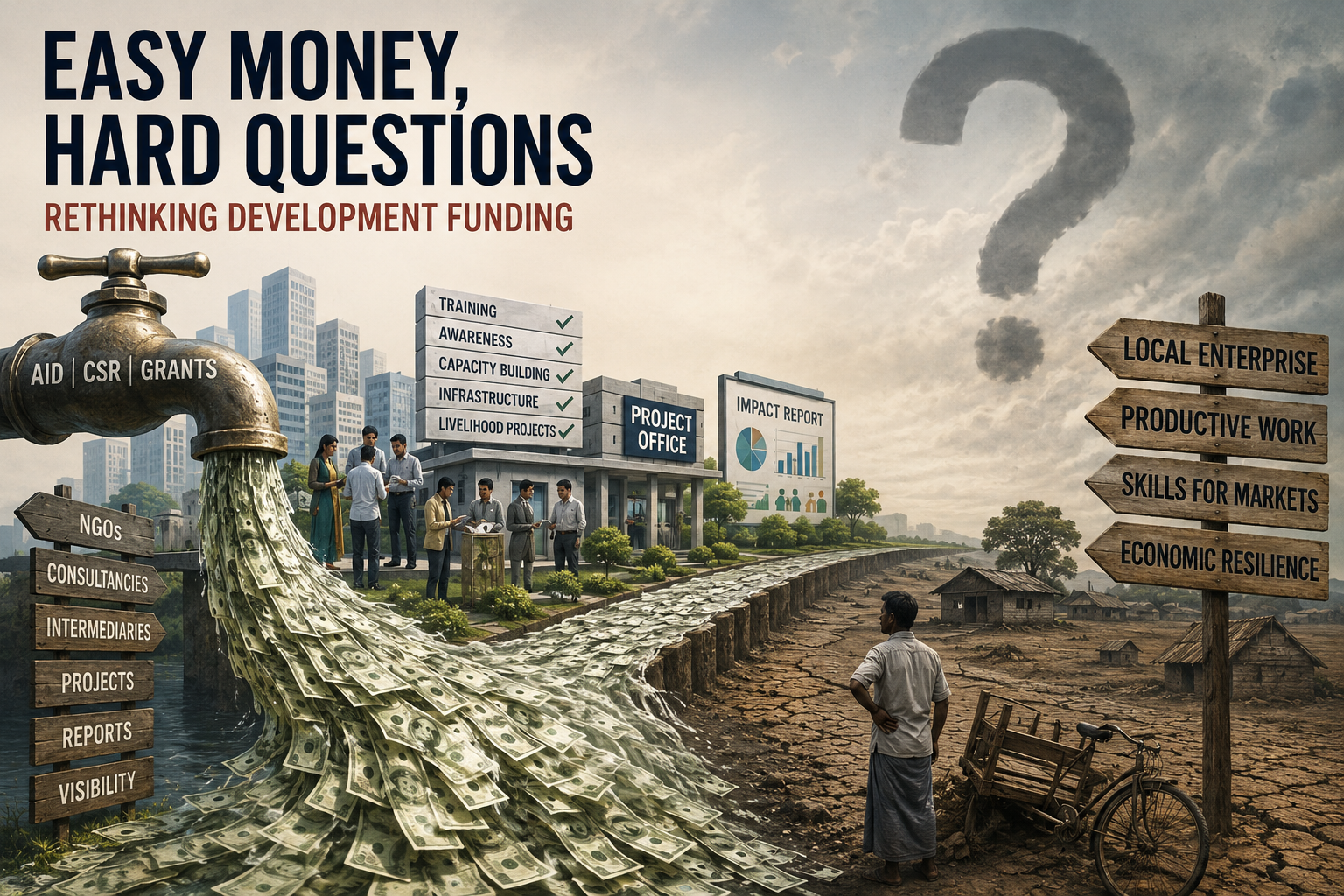
The effects are not merely financial. Over time, “easy money” begins to shape incentives. When funding becomes relatively accessible—whether through international aid, CSR allocations, or development grants—it influences what kind of work is undertaken, which skills are rewarded, and how institutions evolve. Gradually, this can produce a parallel ecosystem of programmes, consultancies, intermediaries, and implementation structures operating alongside, rather than within, the underlying dynamics of local economies.
The consequences of this imbalance are often subtle but profound. Skilled workers increasingly move away from productive activity toward project management and programme administration, while civil society organisations gradually adapt themselves to donor funding cycles rather than long-term economic value creation. Communities become accustomed to interventions that provide temporary relief or visible outputs without necessarily strengthening durable economic capacity. Over time, labour shifts from production to administration, and local skill formation increasingly aligns with donor compliance systems rather than genuine market demand.
The years following the 1999 super cyclone in coastal Odisha offer an important illustration. The inflow of external development funding triggered a rapid expansion of NGO-led and externally supported programmes across affected regions. While many interventions addressed immediate humanitarian needs, local accounts also pointed to an implementation culture where visibility often outweighed long-term economic value. Villagers and locally recruited development workers later recalled instances where assets were created primarily for demonstration purposes. In one such case, a tube well installed was temporarily connected to a nearby water source so that it functioned during inauguration, only to fall into disuse thereafter. Such experiences reflected a broader structural tendency within parts of the development ecosystem to prioritise visible outputs over durable outcomes.
Over time, this has contributed to the emergence of a layered development ecosystem involving NGOs, consulting firms, multilaterals, and multiple tiers of implementation partners. While these actors perform important functions, the expansion of such systems can gradually shift attention from long-term economic resilience toward sustaining funding architectures themselves.
This dynamic is not limited to international aid. It is equally visible in domestic development finance. In India, Corporate Social Responsibility (CSR) funding has evolved into a major pool of development capital, with annual spending crossing ₹35,000 crore (approximately USD 4 billion or more), according to the Ministry of Corporate Affairs’ National CSR Portal (FY 2023-24). Yet this capital remains geographically concentrated in highly industrialised states such as Maharashtra, Gujarat, and Karnataka, reflecting corporate geography more than developmental need. As a result, economically weaker districts often receive only a limited share of such funding, reinforcing existing regional disparities.
Even within this framework, the mode of deployment matters. CSR interventions are frequently project-based, short-term, and centred on training, service delivery, or infrastructure creation. While many perform important functions, such interventions can also reinforce funding-oriented implementation cultures weakly connected to long-term economic value creation. The result is a widening disconnect between development activity and the incentive structures that shape durable economic behaviour.
Today, development finance can no longer be evaluated merely through expenditure levels or project visibility. The larger issue is the incentive structures created through its deployment. Regulation alone cannot address this problem. When development systems continuously reward programme expansion, visibility, and intermediary growth, local economic behaviour gradually adapts around funding cycles rather than durable outcomes. Over time, this risks creating economies that become increasingly programme-dependent while weakening the incentives necessary for genuine long-term transformation.
Author Profile

-
Dr. Perumal Koshy is associated with the Enterprise Futures Lab and is a columnist focused on institutional governance and economic systems. He writes on MSMEs, enterprise development, and policy issues affecting small business ecosystems.
Linkedin: https://www.linkedin.com/in/caushie/
Latest entries
 FEATURED18 July 2026The New Generation of FTAs: Why Services Are Replacing Tariffs as the Main Trade Issue
 FEATURED11 July 2026Beyond Startup Disruption: Why Innovation Must Strengthen Industrial Ecosystems, Not Weaken Them
 FEATURED13 June 2026Beyond Startups and SMEs: Towards an Integrated Enterprise Ecosystem for the Future
 ESG6 June 2026The Scale Obsession: When Institutions Become Bigger Than Their Purpose