




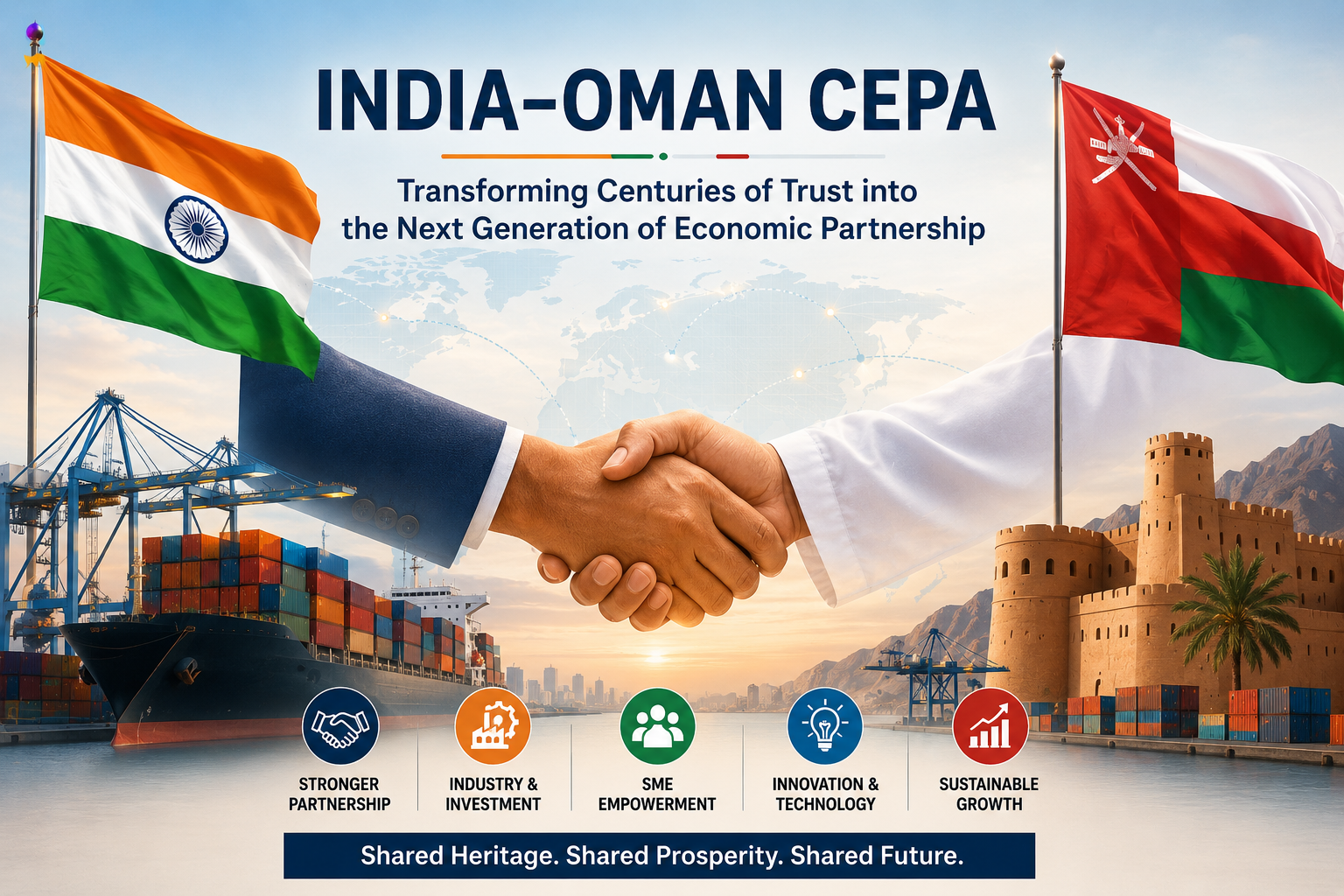
The signing and impending implementation of the India–Oman Comprehensive Economic Partnership Agreement (CEPA) comes at a time when international trade relationships are being reassessed. Businesses are diversifying supply chains, countries are seeking dependable economic partners, and enterprises are exploring markets where long-term cooperation and investment opportunities can be developed.
The India–Oman CEPA should therefore not be viewed merely as another tariff-reduction arrangement. Its larger significance lies in whether it can create a practical ecosystem for investment, enterprise collaboration, technology exchange, and participation of businesses of different scales.
Trade agreements increasingly succeed not only because of preferential market access but because of their ability to create new networks of production, services, innovation, and enterprise partnerships. In this context, the India–Oman CEPA offers both countries an opportunity to transform a historically strong relationship into a modern economic partnership.
A Modern Framework for Historical Ties
The relationship between India and Oman is not new. For centuries, the Arabian Sea connected Omani ports with India’s western coastline, supporting maritime commerce, cultural exchanges, and entrepreneurial networks. Long before contemporary discussions on economic corridors and supply-chain integration, Indian Ocean traders developed partnerships based on mutual trust, mobility, and commercial familiarity.
The CEPA, therefore, does not create a new relationship; it modernizes a centuries-old partnership by providing an institutional platform suited to the requirements of a changing global economy.
The agreement advances toward implementation following the completion of domestic legal processes in both countries. Oman ratified the CEPA through Royal Decree No. 30/2026 issued by Sultan Haitham bin Tarik, while India has operationalized the agreement through its customs and trade framework, including Rules of Origin provisions notified by the Central Board of Indirect Taxes and Customs (CBIC).
Such mechanisms are important because modern trade competitiveness depends not only on reducing tariffs but also on regulatory clarity, transparent procedures, and efficient movement of goods. Rules covering origin requirements, certification, standards, and customs cooperation will ultimately determine how effectively businesses utilize the agreement.
Complementarities Beyond Trade Numbers
India and Oman already share a substantial economic relationship, with bilateral trade reaching approximately US$11 billion in FY2025–26. The strength of this partnership lies in the complementary nature of both economies.
While hydrocarbons and energy products have traditionally shaped a major part of this relationship, the next phase will increasingly depend on diversification into manufacturing, services, technology, food systems and enterprise partnerships.
Oman has built competitive advantages in energy products, petrochemicals, fertilizers, aluminium, minerals, logistics, and industrial infrastructure, while India has expanded capabilities in pharmaceuticals, engineering goods, machinery, processed foods, chemicals, textiles, information technology, and professional services.
Under the CEPA, Oman provides preferential access covering more than 98% of tariff lines, while India has also undertaken significant liberalization commitments. However, the long-term value of the agreement will depend less on tariff numbers alone and more on whether enterprises can convert this access into new commercial relationships.
The real opportunity is not simply whether India exports more products to Oman or Oman increases exports to India. The larger question is whether enterprises from both countries can jointly build regional value chains — producing, processing, financing, servicing, and distributing through shared business platforms.
For Oman, this closely connects with the objectives of Oman Vision 2040, particularly its emphasis on economic diversification, private sector development, and expansion of non-oil activities.
Oman’s investments in logistics and industrial infrastructure, particularly through strategic hubs such as Duqm, Sohar, and Salalah, provide important foundations for deeper economic cooperation. These locations can support manufacturing partnerships, value-added processing, industrial services, warehousing, re-export activities, and regional market development.
Oman’s geographic position offers companies potential access across the Gulf, wider Middle East, and African markets. However, geography alone cannot create competitiveness. Successful trade hubs require efficient institutions, skilled human capital, technology capabilities, financing mechanisms, and strong networks of local suppliers.
The CEPA can provide the enabling framework, but enterprises and institutions must create the economic activity around it.
Making CEPA Work for SMEs
One of the most important tests of the India–Oman CEPA will be whether small and medium enterprises (SMEs) can participate effectively. Experience from trade agreements across different economies shows that smaller enterprises often struggle to benefit even when market access substantially improves.
Their challenges are rarely limited to tariffs. A small manufacturer, service provider, or creative enterprise may have competitive products and capabilities but still face difficulties entering international markets due to certification procedures, standards compliance, documentation requirements, limited networks, and lack of market intelligence.
This implementation gap is often underestimated. Trade agreements open doors, but many smaller enterprises require support systems that help them actually walk through those doors.
Therefore, CEPA implementation must prioritize practical enterprise development mechanisms. This includes SME advisory platforms, simplified cross-border procedures, digital trade facilitation, standards cooperation, access to market information, and targeted business-to-business matchmaking initiatives.
Future cooperation also needs to move beyond traditional buyer–seller relationships. In food security and agriculture, opportunities can extend into processing, packaging, cold-chain infrastructure, and supply-chain partnerships. In healthcare, collaboration can develop around pharmaceuticals, diagnostics, medical technologies, and specialized services.
Similarly, advanced manufacturing can create opportunities in engineering components, industrial maintenance, and technology partnerships. Emerging areas such as clean energy, digital services, and sustainability-focused enterprises provide additional spaces where both economies can develop commercially viable partnerships in emerging industries.
Converting Policy Commitments into Practical Outcomes
Looking toward the next decade, the success of the CEPA will depend on how effectively institutions and businesses convert policy commitments into practical commercial outcomes.
Trade agreements by themselves do not automatically create transformation. They require continuous engagement between companies, investors, industry associations, financial institutions, and governments.
The immediate priority should be building sector-specific business platforms, improving awareness among SMEs, supporting strategic joint ventures, encouraging innovation partnerships, and systematically reducing the operational barriers faced by smaller enterprises.
The India–Oman CEPA represents an important step in strengthening a partnership developed across centuries. Its success should not be measured only through increases in trade statistics, but through the creation of new enterprises, stronger investment relationships, and the ability of smaller businesses to participate in cross-border opportunities. The next phase of India–Oman cooperation may increasingly be shaped not only by movement of goods but also by investment flows, industrial partnerships and knowledge-based services.
The historical foundations already exist. The next challenge is more practical: transforming centuries of commercial familiarity and trust into new enterprises, investments, technologies, and institutions that can define the next phase of India–Oman economic relations.
Author Profile

-
Dr. Perumal Koshy is associated with the Enterprise Futures Lab and is a columnist focused on institutional governance and economic systems. He writes on MSMEs, enterprise development, and policy issues affecting small business ecosystems.
Linkedin: https://www.linkedin.com/in/caushie/
Latest entries
 FEATURED18 July 2026The New Generation of FTAs: Why Services Are Replacing Tariffs as the Main Trade Issue
 FEATURED11 July 2026Beyond Startup Disruption: Why Innovation Must Strengthen Industrial Ecosystems, Not Weaken Them
 FEATURED13 June 2026Beyond Startups and SMEs: Towards an Integrated Enterprise Ecosystem for the Future
 ESG6 June 2026The Scale Obsession: When Institutions Become Bigger Than Their Purpose