





Skip to content
  • News
  • TOP STORIES
  • Enterprise
  • Reports
  • Technology
  • Opinion
  • Reviews
  • Videos
  • Digital issues
  • Issues & Archive
  • Contact

Global SME News

Insights, Policy, and Business Intelligence for SMEs, Businesses, and Entrepreneurs

  • News
  • TOP STORIES
  • Enterprise
  • Reports
  • Technology
  • Opinion
  • Reviews
  • Videos
  • Digital issues
  • Issues & Archive
  • Contact
  • Toggle search form
  • Parametric Weather Insurance Emerges as a Strategic Risk Instrument for SMEs Amid Rising Climate Volatility
    Parametric Weather Insurance Emerges as a Strategic Risk Instrument for SMEs Amid Rising Climate Volatility FEATURED
  • Book Review: Stakeholder Management — Reframing Governance in a Multi-Actor Economy
    Book Review: Stakeholder Management — Reframing Governance in a Multi-Actor Economy Reviews
  • Mira Road: Where Mumbai’s New Luxury Narrative Is Taking Shape FEATURED
  • Qualys Named a Leader in 2026 Forrester Wave™ for Cloud-Native Application Protection Solutions
    Qualys Named a Leader in 2026 Forrester Wave™ for Cloud-Native Application Protection Solutions News
  • Digital Asset Management Market Forecast to Reach USD 17.3 billion by 2033
    Digital Asset Management Market Forecast to Reach USD 17.3 billion by 2033 News
  • Thane’s Wagle Estate as a Key Commercial and Business Destination
    Thane’s Wagle Estate as a Key Commercial and Business Destination FEATURED
  • Automotive Brake Fluid Market: From Consumable Input to Safety-Critical Technology Segment
    Automotive Brake Fluid Market: From Consumable Input to Safety-Critical Technology Segment FEATURED
  • From Survival to Strategic Resilience: What MSMEs need in a fragmenting global economy
    From Survival to Strategic Resilience: What MSMEs need in a fragmenting global economy FEATURED
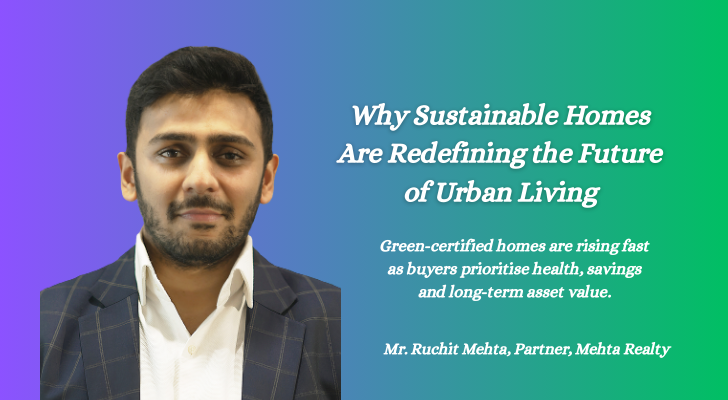
The rise of eco-living: Why the demand for sustainable homes is accelerating in Indian cities

The rise of eco-living: Why the demand for sustainable homes is accelerating in Indian cities

Posted on 1 December 20251 December 2025 By Ruchit Mehta No Comments on The rise of eco-living: Why the demand for sustainable homes is accelerating in Indian cities

Luxury housing in India is undergoing a fundamental shift. What was once synonymous with grand foyers, imported fixtures and expansive amenities is now being redefined by sustainability, wellness and long-term value creation. The new markers of luxury in urban India are clean air, natural light, energy-efficient designs and responsible material use. This is not simply a lifestyle trend—it reflects a structural transformation underway in the country’s residential real estate market.

Industry estimates show that India’s green building segment is expanding at an unprecedented pace. The market is projected to grow from USD 37.99 billion in FY2024 to USD 85.00 billion by FY2032, at a CAGR of 10.59 per cent. This surge is driven by heightened environmental awareness, post-pandemic prioritisation of health, and the growing preference for homes that minimise both ecological impact and operating costs. Features such as improved ventilation, daylight optimisation, energy-efficient systems and water-saving fixtures—earlier treated as optional add-ons—have become central decision-making factors for homebuyers.

A generational shift

Millennials, who will make up more than 60 per cent of the global workforce by 2030, are now the dominant homebuying cohort in Indian cities. A 2023 survey found that nearly 75 per cent of millennials are willing to pay a premium for homes with sustainable value-adds. Knight Frank’s research further indicates that HNIs, UHNIs and NRIs increasingly prefer green-certified properties.

While environmental consciousness plays a role, economic rationality is equally influential. Data from the Indian Green Building Council (IGBC) shows that certified green homes can deliver 30–50 per cent energy savings and up to 50 per cent water savings. For younger buyers in particular, the long-term reduction in household expenditure has become a compelling determinant of purchase decisions.

Greener, smarter

Advances in technology and supportive policy interventions have narrowed the gap between higher upfront costs and eventual payback. According to the CII Green Building Congress, the payback period for green investments has shortened to just three to five years.

The financial advantages extend well beyond utility savings. A JLL study reports that green-certified residential and commercial buildings in major metropolitan areas command 11 per cent higher rents and 21 per cent higher sales premiums. These assets also tend to appreciate faster, with green-certified properties attracting up to 15 per cent more investor interest and earning around 10 per cent higher rentals. Lower vacancy rates, stronger tenant retention, and resilience against market volatility make such properties particularly attractive in an uncertain global environment.

Regulatory push

India’s policy ecosystem is strongly aligned with the country’s green building ambitions. The Energy Conservation Building Code (ECBC), enforced by the Bureau of Energy Efficiency, sets mandatory efficiency standards that have already reduced energy consumption by up to 40 per cent in compliant buildings.

Several states—including Haryana, Rajasthan and Tamil Nadu—offer powerful incentives such as additional Floor Area Ratio (FAR), tax rebates and fast-track environmental clearances for projects certified by IGBC or GRIHA. The emergence of sustainable Real Estate Investment Trusts (REITs), with annual investments expected to cross ₹8,000 crore by 2025, reflects the growing institutional appetite for green assets.

The Real Estate Regulatory Authority (RERA) has also placed greater emphasis on sustainability, requiring developers to disclose green features and environmentally sound design elements in their project specifications. Complementary national programs such as the Smart Cities Mission, led by the Ministry of Housing and Urban Affairs, are embedding green building norms directly into urban development frameworks. These efforts collectively align India’s real estate sector with the country’s Net Zero 2070 commitment.

The new mainstream

Sustainable homes are no longer niche offerings; they are steadily becoming the preferred choice for urban buyers. Whether driven by immediate wellness considerations, mid-term savings or long-term asset appreciation, eco-friendly housing options now define the trajectory of India’s residential real estate market.

Prospective buyers are advised to evaluate project certifications (such as IGBC or GRIHA), review sustainability features in detail, and request quantifiable estimates of anticipated savings on energy and water use. Such due diligence ensures that the benefits of green living fully translate into everyday experience and long-term financial value.

Eco-living is not simply a trend—it is the new foundation of urban housing in India, reflecting a future where luxury and sustainability are inseparable.

Author Profile

Ruchit Mehta
Mr. Ruchit Mehta is the Partner, Mehta Realty
Latest entries

Author Archives

  • The rise of eco-living: Why the demand for sustainable homes is accelerating in Indian citiesUncategorised1 December 2025The rise of eco-living: Why the demand for sustainable homes is accelerating in Indian cities

Uncategorised

Post navigation

Previous Post: LogRhythm | Exabeam Expands Saudi Presence with MIS Partnership and New Customer Innovation Center in Riyadh
Next Post: Digital Terrain Database Market Set to Reach USD 3.8 Billion by 2033

Leave a Reply Cancel reply

Your email address will not be published. Required fields are marked *

Global SME News

Global SME News, which started in 2008, is dedicated to micro, small and medium enterprises from around the world. It publishes in-depth analysis, market and sectoral reviews as well as news than can help SMEs stay ahead of the curve and acquire the necessary tools to stay relevant in the market.

  • Scaling SMEs: Why Governance Matters as Much as Growth
    Scaling SMEs: Why Governance Matters as Much as Growth FEATURED
  • Empowering Women Entrepreneurs: Rabeha Programme Boosts Market Access for Handicraft Enterprises in Egypt
    Empowering Women Entrepreneurs: Rabeha Programme Boosts Market Access for Handicraft Enterprises in Egypt News
  • Abu Dhabi launches the unified economic licence  to enhance ease of doing business
    Abu Dhabi launches the unified economic licence  to enhance ease of doing business Business
  • Parametric Weather Insurance Emerges as a Strategic Risk Instrument for SMEs Amid Rising Climate Volatility
    Parametric Weather Insurance Emerges as a Strategic Risk Instrument for SMEs Amid Rising Climate Volatility FEATURED
  • Solar power can make SMEs sustainable
    Solar power can make SMEs sustainable Opinion
  • Digital Asset Management Market Forecast to Reach USD 17.3 billion by 2033
    Digital Asset Management Market Forecast to Reach USD 17.3 billion by 2033 News
  • Mandiant Introduces New Managed Detection and Response Service for Microsoft Defender for Endpoint
    Mandiant Introduces New Managed Detection and Response Service for Microsoft Defender for Endpoint Cyber Security
  • Trinasolar Expands Renewable Energy Footprint in MENA with Strategic 110MW Vertex N Module Partnerships
    Trinasolar Expands Renewable Energy Footprint in MENA with Strategic 110MW Vertex N Module Partnerships Business
  • Parametric Weather Insurance Emerges as a Strategic Risk Instrument for SMEs Amid Rising Climate Volatility
  • Book Review: Stakeholder Management — Reframing Governance in a Multi-Actor Economy
  • Mira Road: Where Mumbai’s New Luxury Narrative Is Taking Shape
  • Qualys Named a Leader in 2026 Forrester Wave™ for Cloud-Native Application Protection Solutions
  • Digital Asset Management Market Forecast to Reach USD 17.3 billion by 2033

Copyright © 2026 Global SME News.

Powered by PressBook News WordPress theme