






More enabling digital regulations could generate ₩2.4 trillion (US$1.73 billion) in additional annual VC investment for South Korean startups and support 21,000 jobs by 2035, an Oxford Economics study finds.
South Korea, August 2026: More enabling digital regulations could support an additional ₩2.4 trillion (approximately US$1.73 billion) in venture capital investment annually in South Korea while accelerating startup creation and employment, according to a new study by Oxford Economics commissioned by Digital Prosperity Asia.
The study, Digital Regulations and the Startup Ecosystem in South Korea, is based on a survey of 500 startup ecosystem stakeholders, including 350 startups, 100 venture capital firms, and 50 incubators, together with expert interviews and quantitative modelling.
Oxford Economics estimates that a shift towards a more flexible and enabling digital regulatory environment could increase startup formation by 15% and VC funding by nearly 20% over the 2026–2035 period. This could translate into around 240 additional startups every year, ₩2.4 trillion (US$1.73 billion) in additional annual VC investment and approximately 21,000 startup jobs supported by 2035.
Digital Regulations Increasing Costs for South Korean Startups
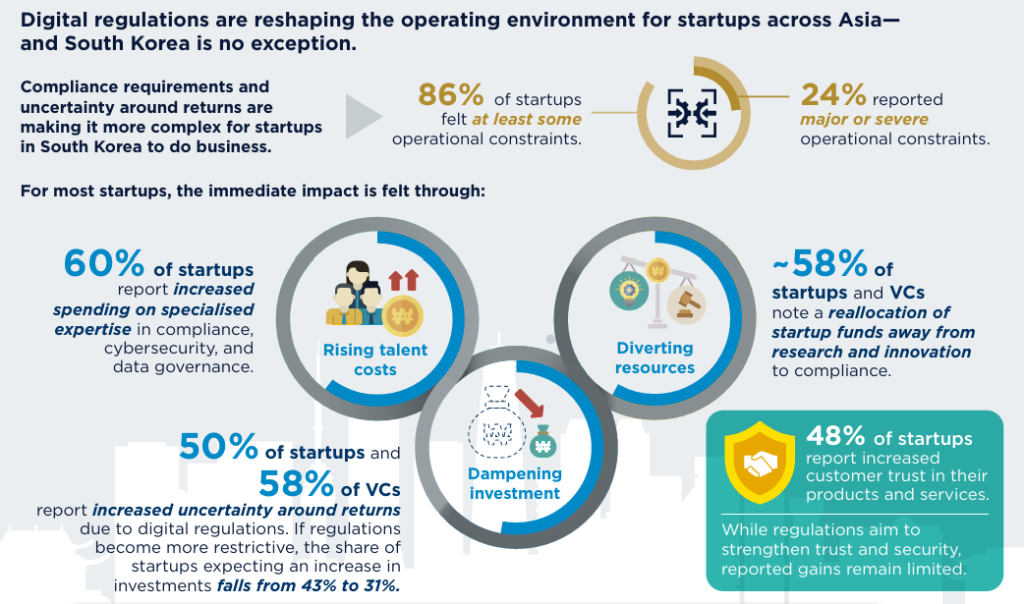
The findings also point to the growing compliance burden facing startups. Around 86% of startups surveyed reported at least some operational constraints from digital regulations, with 24% describing the constraints as major or severe. More than three-quarters spend over 5% of their operating costs on compliance.
Regulatory requirements are also affecting how startups allocate resources. Nearly 58% of startups said financial resources were being diverted from research and development towards compliance, while 46% reported delays in product development or longer time-to-market.
Investment uncertainty is another concern. 50% of startups and 58% of venture capital firms said digital regulations increased uncertainty around investment returns. Nearly half of investors responding to these concerns have adopted more cautious investment strategies.
Restrictive Regulations Could Reduce VC Investment
The economic implications could move in the opposite direction if South Korea adopts a more restrictive regulatory trajectory.
Oxford Economics estimates that a more restrictive environment could result in 8% fewer startups, equivalent to around 130 fewer new firms annually, and 10% lower VC funding, or approximately ₩1.3 trillion (US$935 million) less investment each year between 2026 and 2035. Around 12,000 fewer startup jobs could consequently be supported by 2035.
Better Regulation Key to South Korea’s Startup Growth
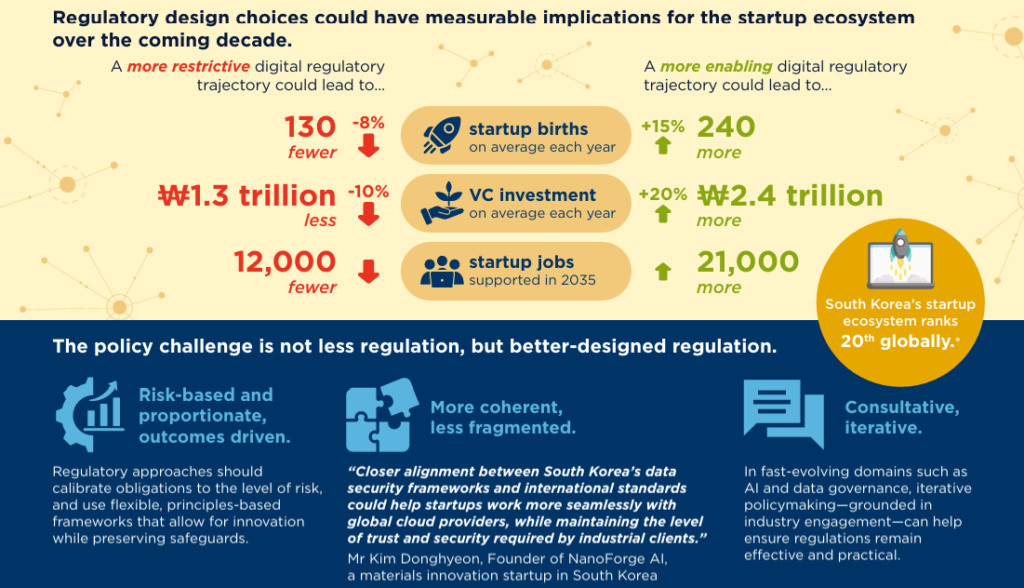
The report stresses that the policy issue is not less regulation, but better-designed regulation. It calls for regulatory approaches that are risk-based, proportionate and focused on outcomes, alongside greater coherence between regulatory agencies and closer alignment with international standards.
For emerging areas such as artificial intelligence and data governance, the study highlights the importance of flexible regulatory frameworks and continued engagement between policymakers, startups, investors and technology experts.
With South Korea already ranked among the world’s leading startup ecosystems, the findings suggest that the design of digital regulation could become an increasingly important factor determining the ability of Korean startups to attract venture capital, innovate, scale and compete internationally.
Author Profile
Latest entries
 Entreprenurs7 August 2026More Enabling Digital Regulations Could Add ₩2.4 Trillion (US$1.73 Billion) in Annual VC Investment for South Korean Startups: Oxford Economics
 AI24 July 2026The Creator Economy Platform Market: AI, Digital Entrepreneurship, and the Future of Online Business
 FEATURED9 July 2026Bluevine Expands U.S. Business Banking Solutions to India-Based Entrepreneurs
 FEATURED2 April 2026Parametric Weather Insurance Emerges as a Strategic Risk Instrument for SMEs Amid Rising Climate Volatility