





Kuala Lumpur, Malaysia, July 14, 2026 – Malaysia’s startup ecosystem could lose an estimated RM792 million (approximately US$186 million) in annual venture capital (VC) investment over the next decade if digital regulations become more restrictive, according to a new study by Oxford Economics commissioned by Digital Prosperity Asia (DPA). The report concludes that while Malaysia has so far maintained a relatively balanced and enabling regulatory framework for the digital economy, future policy decisions will have profound implications for entrepreneurship, innovation and investment.

The study, Digital Regulations and the Startup Ecosystem in Malaysia, draws on a survey of 500 startup ecosystem stakeholders across Malaysia, expert interviews and quantitative economic modelling. It examines how digital regulations influence business operations, compliance costs, talent acquisition, innovation and investment decisions.
According to the study, digital regulation has evolved from being a compliance obligation into a strategic business consideration that affects nearly every stage of a startup’s growth.
“The study highlights how regulations influence decisions across Malaysia’s startup ecosystem,” said Henry Worthington, Managing Director, Economic Consulting at Oxford Economics. “Startups face immediate pressures as they navigate compliance across a broad range of digital regulations. Meeting these requirements often demands specialised talent and changes to operating models, diverting resources from innovation and growth. Investors also consider a startup’s ability to meet regulatory obligations when making investment decisions. The implication is not that safeguards should be weakened, but that regulatory design, proportionality and predictability will be critical to sustaining Malaysia’s startup momentum.”
Compliance Becoming a Structural Business Cost
The report finds that compliance has become a permanent operational expense rather than a one-time regulatory exercise. Malaysian startups are increasingly redesigning internal processes, investing in compliance systems and engaging specialist legal and advisory services to satisfy evolving digital regulations.
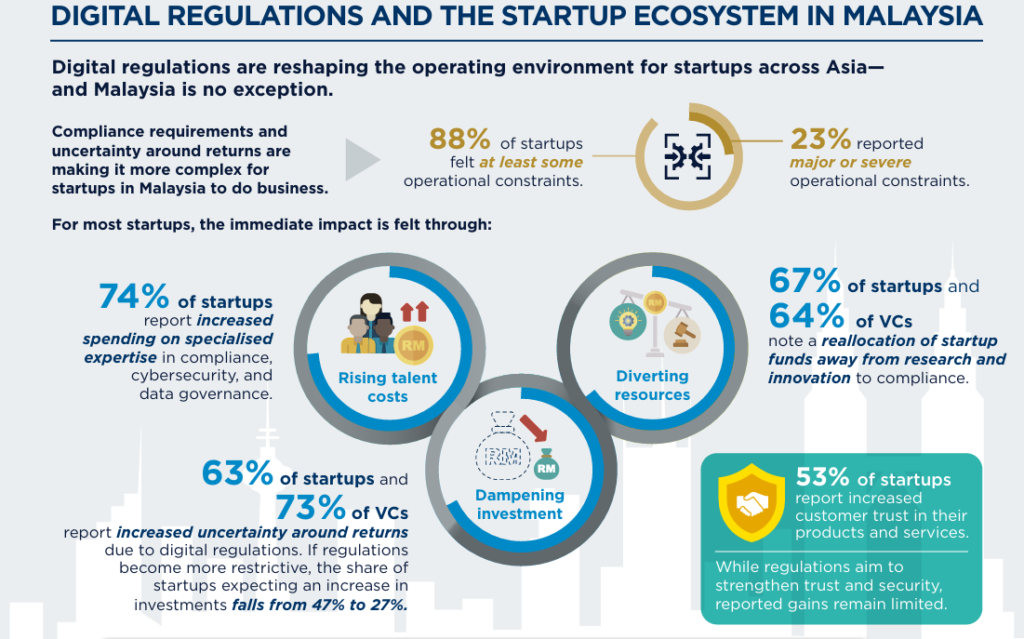
Nearly 88% of startups surveyed reported that digital regulations create operational constraints, with 23% describing the impact as major or severe. More than 81% said compliance requirements have increased business costs. Of these, more than eight out of ten allocate over 5% of their operating expenditure to compliance activities, while 39% spend more than 15% of their operating budgets on regulatory compliance.
The study also found that 68% of startups have already undertaken significant organisational changes to comply with digital regulations, including establishing new compliance procedures, migrating workloads to compliant cloud infrastructure and retaining external legal and regulatory advisers.
Compliance Pressures Diverting Resources from Innovation
Oxford Economics found that regulatory compliance is reshaping workforce planning and innovation strategies across Malaysia’s startup ecosystem.
Approximately 87% of startups reported that digital regulations have affected workforce costs or talent management. Around 74% indicated rising expenditure on specialised professionals in compliance, cybersecurity and data governance.
The financial burden of compliance is also reducing investment in innovation. Nearly 67% of startups said resources originally earmarked for research and development (R&D) are being redirected towards compliance-related activities. Similar concerns were expressed by 64% of venture capital firms and startup incubators surveyed.
These pressures are beginning to affect product development and commercialisation. Around 57% of startups reported delays in product launches and longer time-to-market, while 59% of venture capital investors observed a slowdown in innovation across the startup ecosystem.
Regulatory Uncertainty Influencing Investment Decisions
The report also highlights growing investor concern regarding the future direction of Malaysia’s digital regulatory framework.
Nearly 63% of startups said digital regulations increase market uncertainty and make fundraising more difficult. Among venture capital firms, 73% believe regulatory uncertainty reduces confidence in future investment returns.
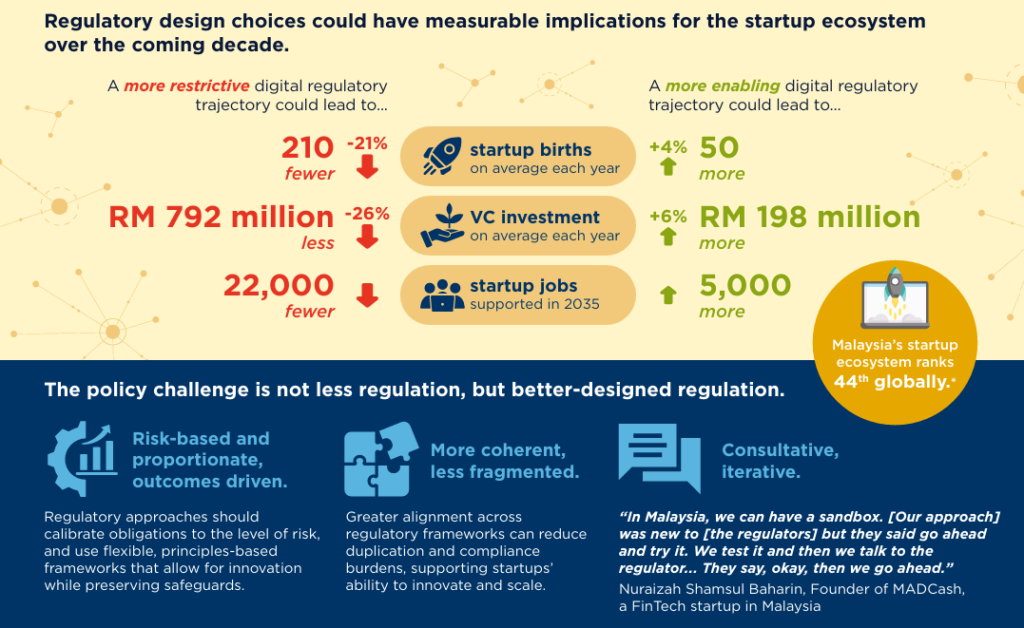
Oxford Economics’ economic modelling estimates that under a more restrictive regulatory environment between 2026 and 2035, Malaysia could experience a 26% reduction in venture capital funding, equivalent to approximately RM792 million (US$186 million) less investment every year.
Conversely, a more enabling regulatory framework could increase venture capital investment by 6%, generating an additional RM198 million (approximately US$47 million) in annual VC funding during the same period.
The study also found that investor sentiment is already sensitive to anticipated regulatory changes. Under a more restrictive policy scenario, the proportion of startups expecting increased investment declines sharply from 47% to 27%. In response, investors are strengthening compliance due diligence and incorporating regulatory risk assessments more prominently into investment decisions.
Preserving Malaysia’s Digital Growth Momentum
Digital Prosperity Asia believes Malaysia has established a strong foundation for digital innovation through its balanced regulatory approach but cautions that maintaining this balance will be essential as new regulations governing artificial intelligence, cybersecurity and data governance continue to emerge.
“Malaysia has made important progress in building a digital economy that supports innovation, and its relatively enabling regulatory approach is an important asset for startups,” said Koh Liang Wei from the DPA Secretariat. “As Malaysia’s rules on data, cybersecurity and AI continue to evolve, the priority should be to preserve that balance. For SMEs and startups, clear, coherent and consultative regulation is not just a policy preference. It shapes whether limited resources go into compliance, or into hiring, product development and regional expansion.”
He added that Digital Prosperity Asia looks forward to supporting continued dialogue between policymakers, entrepreneurs and investors to ensure future regulations protect public trust while enabling innovation and sustainable economic growth.
The findings underscore the increasingly important relationship between regulatory certainty and entrepreneurial success. As Malaysia strengthens its position as a regional digital economy, policymakers face the challenge of designing regulatory frameworks that safeguard consumers and national interests without undermining innovation, startup competitiveness or long-term investment.
Author Profile
Latest entries
 FEATURED24 July 2026SME Chamber of India Appoints Jhumarmal Tunwal, Chairman & Managing Director of Tunwal E-Motors as Vice President
 FEATURED23 July 2026Neuberg Diagnostics Cuts Manual HR Tasks by 90% Through AI-Powered HR Transformation with OfficeNet
 FEATURED23 July 2026Gen Z Insurance Advisors Lead in Policy Volumes, While Experienced Advisors Drive Deep Protection Conversations: Probus Report
 FEATURED16 July 2026Currys Business Expands Business Hub Network to Strengthen Technology Support for UK SMEs