


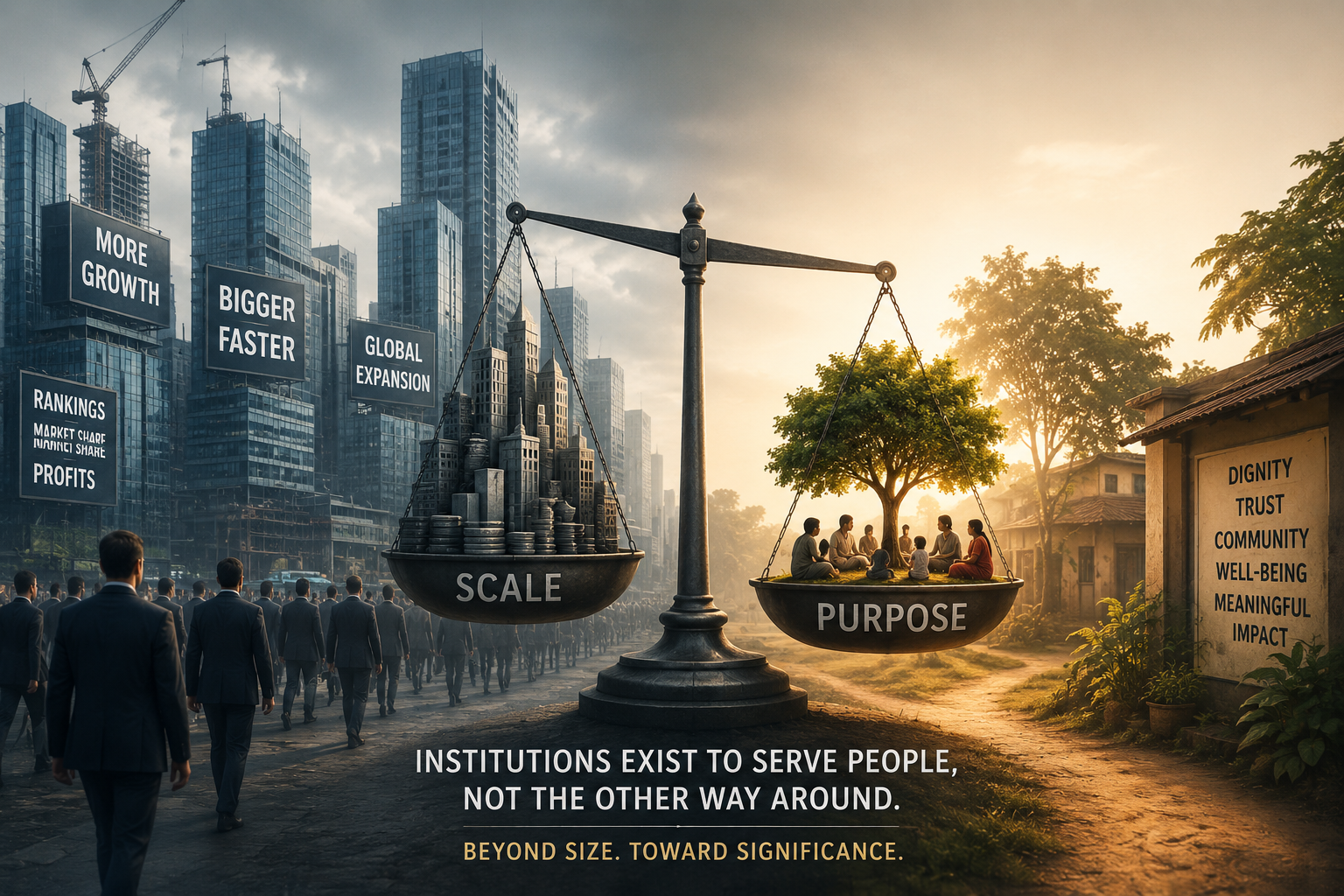
One of the defining characteristics of our time is the belief that every meaningful effort must eventually become bigger, faster and globally visible. A business idea must become a unicorn. A startup must disrupt an industry. A corporation must continuously expand. A social initiative must reach millions. Nations must compete over economic size, rankings and spectacular achievements.
The problem is not scale itself. Growth has always been part of human progress. Societies advanced because people imagined possibilities beyond existing limitations. Enterprises expanded because entrepreneurs identified opportunities and created new markets. Institutions grew because ideas travelled beyond their original boundaries.
The problem begins when scale stops being the natural outcome of creating value and becomes the primary objective.
When Growth Replaces Purpose
Many startups today operate within this contradiction. A founder is often not encouraged simply to build a meaningful enterprise that solves a problem, serves customers, provides employment and becomes financially sustainable. The expectation is frequently much larger — capture the market, dominate the sector, expand rapidly and become a global success story.
This creates a particular kind of organizational culture. When a venture begins to see itself as being in a constant race to conquer a market, the basic principles of building a lasting institution may appear too slow. Taking time to understand, improve and evolve can look like hesitation. Sustainable growth may be mistaken for lack of ambition. Questioning unrealistic expansion may be seen as resistance to the mission.
The result is that organizations created around innovation can sometimes reproduce unhealthy work cultures built around constant urgency and pressure. The challenge is not ambition. Ambition has created some of humanity’s greatest achievements. The challenge emerges when ambition becomes disconnected from the purpose that originally justified growth.
The Myth of Endless Work
However, this mindset is not limited to young founders or startups. It appears across different forms of leadership, including among experienced business leaders who have built successful organizations.
The recent debates around seventy or eighty-hour work weeks reflect this larger question. Behind such arguments is often the assumption that enterprises and nations progress primarily when people spend more hours working. More time at work becomes associated with greater commitment, and personal sacrifice becomes linked with organizational or national achievement.
But history shows that development is not merely the result of increasing the quantity of work. If longer working hours alone created prosperity, societies with the most exhausting working conditions would automatically become the most advanced economies. The transformation of nations and enterprises comes from improving what human effort can achieve — through knowledge, technology, better institutions, creativity, skills, management practices and productivity. There is a fundamental difference between building a culture of excellence and building a culture of exhaustion.
Modern Institutions and the Human Question
Large corporations are equally vulnerable to the scale obsession. Modern offices, advanced technologies, attractive workplaces, recreational spaces and sophisticated management systems do not automatically create humane organizations.
A workplace is not defined by its coffee machines, gyms or carefully designed spaces. It is defined by trust, fairness, dignity and the everyday experience of people who work there. A highly modern workplace can still operate through excessive monitoring, constant measurement and systems where employees are viewed primarily as resources for achieving larger organizational ambitions.
When Missions Become Metrics
Even social organizations and non-profit institutions are not free from this tendency. Organizations that begin with powerful missions to serve communities may gradually find themselves measuring success mainly through expansion — number of beneficiaries, number of locations, funding size, visibility and institutional reach.These indicators may have relevance, but they cannot replace the deeper purpose of social transformation.
A small initiative creating meaningful and lasting change within a community may sometimes contribute more than a large programme that expands widely without creating deeper impact. The purpose of a mission is not simply to become bigger. Similar patterns can also emerge within faith-based and spiritual organizations across traditions.Institutions originally built around compassion, service, ethical values and community can sometimes begin measuring influence through size, wealth, infrastructure and expansion.
When institutional growth becomes more important than the values that created the institution, the original mission gradually becomes secondary.
Beyond Rankings and Numbers
The same challenge exists at the level of nations. Countries naturally aspire for economic growth, technological advancement and global recognition. These ambitions are important. No society can ignore productivity, investment or economic expansion.
However, GDP figures, rankings and large achievements are indicators of progress. They are not the purpose of development itself. The ultimate purpose of development is improving human life — better opportunities, stronger communities, better health, education, security, dignity and the freedom for people to realise their capabilities.
This question is not new. Many streams of economic thought, including Gandhian economic thinking, raised concerns about development becoming separated from human needs and community well-being.
Gandhi’s famous Talisman — a moral guide he offered for evaluating decisions — provided a simple but profound test: before taking any major step, remember the face of the weakest and most vulnerable person and ask whether that action would improve their life and dignity.
Although expressed in a different historical context, this principle remains deeply relevant to modern economic and institutional life. It is not only a philosophy for small communities or traditional systems. The same question applies to startups seeking rapid growth, corporations pursuing global expansion, social organizations increasing their reach and nations competing for economic progress.
The fundamental question is whether growth continues to serve people, or whether people gradually become instruments for achieving growth.Human beings are not simply economic resources to be maximized. Economic systems exist to improve human life; human life should not become a permanent sacrifice for economic systems.
The Real Measure of Progress
Large institutions can create extraordinary possibilities when their growth strengthens their original purpose. Small institutions can also lose direction when they become disconnected from the values that created them.The question before startups, corporations, social organizations and nations is not only: How big can we become? The more important question is: What value are we creating, and for whom?
Scale has meaning only when it strengthens the purpose that created an institution. When scale becomes the purpose itself, organizations may continue growing while slowly moving away from the people and problems they originally intended to serve. The real question is therefore not size itself, but whether growth continues to serve people, communities and society. Contemporary debates on responsible business, sustainability and governance also reflect this larger concern — those institutions cannot be judged only by expansion and economic performance, but by the wider value they create.
(Perumal Koshy)
Author Profile

-
Dr. Perumal Koshy is associated with the Enterprise Futures Lab and is a columnist focused on institutional governance and economic systems. He writes on MSMEs, enterprise development, and policy issues affecting small business ecosystems.
Linkedin: https://www.linkedin.com/in/caushie/
Latest entries
 FEATURED18 July 2026The New Generation of FTAs: Why Services Are Replacing Tariffs as the Main Trade Issue
 FEATURED11 July 2026Beyond Startup Disruption: Why Innovation Must Strengthen Industrial Ecosystems, Not Weaken Them
 FEATURED13 June 2026Beyond Startups and SMEs: Towards an Integrated Enterprise Ecosystem for the Future
 ESG6 June 2026The Scale Obsession: When Institutions Become Bigger Than Their Purpose